
Megachile lanata
(Fabricius, 1775)
Woolly Wall Bee
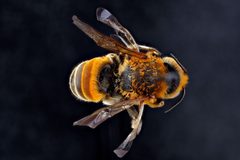
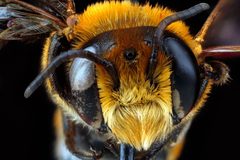
Megachile lanata is a solitary leafcutter bee in the Megachilidae, described by Fabricius in 1775. It is considered an in Pakistan and has been introduced to regions including Colombia and Florida. The is an important of horticultural, ornamental, aromatic, and agricultural crops. Studies have documented its nesting in pre-existing cavities and its foraging activity across diverse landscapes.
Pronunciation
How to pronounce Megachile lanata: /ˌmɛɡəˈkaɪli ˈlænətə/
These audio files are automatically generated. While they are not always 100% accurate, they are a good starting point.
Images
Habitat
Agricultural landscapes, forests, urban areas, and natural ; specifically documented in agro- on the Pothohar Plateau, Punjab, Pakistan, and at an Agricultural Research Station in Vijayarai, Andhra Pradesh, India. Nests in pre-existing cavities, including artificial substrates with diameters of 0.8–1.0 cm.
Distribution
Native to the Old World; in Pakistan. Documented in Pothohar Plateau, Punjab, Pakistan; Vijayarai, Andhra Pradesh, India; also recorded in Colombia, Florida (USA), and across Africa, the Caribbean, North America, Oceania, and South America according to distribution records.
Seasonality
Active during 2021–2022 in Pakistan study; 2023–2024 in India study. Monthly collection efforts suggest year-round activity with seasonal fluctuations.
Diet
Pollen and nectar from floral plants; foraging activity observed across multiple crop types with differential visitation rates.
Life Cycle
Constructs linear series of in pre-existing cavities using leaf material and red earth.
Behavior
Exhibits distinct temporal foraging patterns with differential visitation rates across crops. Prefers mid-range substrate diameters (0.8–1.0 cm) for nesting. Solitary nesting with leaf-cutting and resin-collecting activities for construction.
Ecological Role
Important that increases yield and quality of horticultural, ornamental, aromatic, and agricultural crops. Contributes to health, particularly in agro-ecosystems.
Human Relevance
Valued as a crop in agricultural systems. status in Pakistan may pose ecological concerns.
Sources and further reading
- BugGuide
- Wikipedia
- GBIF taxonomy match
- iNaturalist taxon
- NCBI Taxonomy
- Catalogue of Life
- Looking for Cheap Urban Real Estate | Bug Squad
- In Search of the World's Biggest Bee: How It Came to 'Bee' | Bug Squad
- Photographer Allan Jones Exudes Patience, Skill and Talent | Bug Squad
- The Most Incredible Image of a Leafcutter Bee | Bug Squad
- The Native Bees in the UC Davis Bee Haven | Bug Squad
- Mailbox posts are fine homes for giant resin bees, Megachile sculpturalis — Bug of the Week
- Foraging Activity and Nesting Behaviour of Leafcutter Bees, Megachile lanata (F.) and Megachile disjuncta (F.)
- Distribution and host plant associations of Megachile (Pseudomegachile) lanata (Fabricius, 1775) (Megachilidae) in Pothohar, Pakistan