
Coelioxys obtusiventris
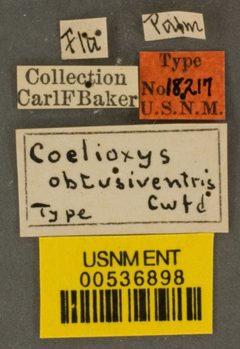
Crawford, 1914
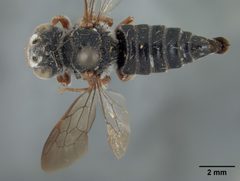
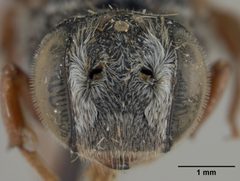
Coelioxys obtusiventris is a of cuckoo bee in the Megachilidae, first described by Crawford in 1914. Like other members of the Coelioxys, this species is a that exploits the nests of leafcutter bees (Megachile spp.). The female lays her in the 's provisioned nest , and her larva kills the host egg or larva before consuming the stored pollen and nectar. This species occurs in North America and is one of approximately 50 species in the genus Coelioxys worldwide.
Pronunciation
How to pronounce Coelioxys obtusiventris: /ˌsiːliˈɒksɪs ˌɒbtjuːsiˈvɛntrɪs/
These audio files are automatically generated. While they are not always 100% accurate, they are a good starting point.
Identification
Members of Coelioxys can be distinguished from their Megachile by the pointed or tapering , which terminates in a sharp spine or point—a feature absent in Megachile. Males typically have more extensively modified abdominal tips than females. Coelioxys obtusiventris specifically may be distinguished from by subtle morphological features of the abdominal apex, though precise diagnostic characters require examination. The has relatively sparse body hair compared to many Megachile and often displays banded abdominal coloration.
Images
Habitat
Found in environments where leafcutter bees (Megachile spp.) nest, including areas with suitable nesting substrates such as hollow twigs, borings in dead wood, and artificial hotels or bee condos. Associated with flowering that support of Megachile hosts, including gardens, meadows, and open woodlands with abundant pollen and nectar sources.
Distribution
North America. GBIF records indicate presence in North America with distribution records specifically noting the region as present. The was described from North American material by Crawford in 1914.
Diet
As a , the larva feeds on the pollen and nectar provisions stored by the female leafcutter bee (Megachile spp.). The female does not collect pollen; adults may visit flowers for nectar.
Host Associations
- Megachile - Nests of leafcutter bees; female C. obtusiventris lays in provisioned
Life Cycle
The female seeks out open, unsealed nest of Megachile and deposits her between the leaf fragments lining the cell. Upon hatching, the Coelioxys larva kills the host egg or larva and completes development on the host's pollen-nectar provision. The presumably overwinters as a mature larva or pupa within the host nest, emerging as an the following season. Specific for C. obtusiventris is not documented, but Coelioxys species generally are active during the period of their Megachile hosts.
Behavior
Females are known to hover near nesting sites, searching for opportunities to enter unsealed nest . They do not construct their own nests or collect pollen. Males may be observed patrolling flowers, particularly those visited by females. The is solitary, with no social organization.
Ecological Role
Acts as a regulator of leafcutter bee (Megachile) populations through . Contributes to dynamics as a member of the cleptoparasitic guild, though specific quantitative impacts on populations are unstudied for this .
Human Relevance
Has been observed in garden settings where artificial hotels attract Megachile . May be encountered by gardeners monitoring solitary bee nesting blocks. No direct economic importance documented, though presence indicates healthy of host leafcutter bees.
Similar Taxa
- Coelioxys rufitarsisAlso a North American cuckoo leafcutter bee; identification to level requires examination of abdominal and male genitalia
- Coelioxys sodalisOverlapping distribution and use; subtle differences in abdominal shape and punctation distinguish the
- NomadaAnother of cuckoo bees, but parasitizes Andrena and other mining bees rather than Megachile; typically more -like in appearance with yellow and black or red and black markings