
Trachusa
Panzer, 1804
Species Guides
8- Trachusa cordaticeps(Cordate-headed Resin-Leafcutter)
- Trachusa dorsalis(Stripe-backed Resin-Leafcutter)
- Trachusa fontemvitae
- Trachusa larreae
- Trachusa manni
- Trachusa perdita(California leafcutting bee)
- Trachusa timberlakei(Timberlake's Resin-Leafcutter)
- Trachusa zebrata(Zebra Resin-Leafcutter)
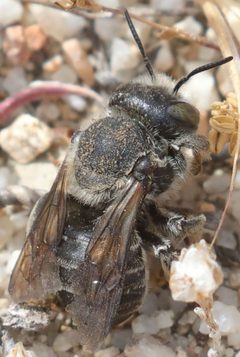
Trachusa is a of resin bees in the Megachilidae, tribe Anthidiini, comprising at least 50 described distributed across the Palearctic region. Recent taxonomic revisions have revealed extensive cryptic diversity, with several (e.g., T. interrupta and T. pubescens groups) resolved from formerly recognized single widespread species into multiple distinct, often or narrowly sympatric species. These bees are characterized by resin-collecting and are classified as leafcutter, mason, and resin bees, though specific nesting is documented for few species.


Pronunciation
How to pronounce Trachusa: /tɹəˈkjuːsə/
These audio files are automatically generated. While they are not always 100% accurate, they are a good starting point.
Identification
Members of Trachusa can be distinguished from other Anthidiini by the combination of: (1) presence of yellow maculations on , mesosoma, and metasoma with relatively consistent patterns within ; (2) structural features of the head including and ; (3) male genitalia and characteristics used in species-level identification. Within the , require morphometric analysis of multiple body measurements (15–26 characters including head dimensions, antennal length, and wing morphology) combined with examination of type material for reliable identification. Colour pattern variation alone is insufficient for species delimitation due to geographic and overlapping variation between closely related .
Images
Distribution
Palearctic distribution extending from northwest Africa and the Iberian Peninsula westward to Central Asia and China eastward. show structured geographic patterns: the T. interrupta complex includes three widespread (T. interrupta s.str., T. integra, T. anatolica) across Western Mediterranean to Central Asia, plus five restricted-range species in southern regions (Spain, northwestern Africa, Turkey, Iran). The T. pubescens complex occurs from southeastern Europe through Anatolia, the Caucasus, Iran, and Turkmenistan. China nine confirmed species including three to the region. Distribution patterns within species complexes typically show allopatry or minimal parapatric overlap; sympatry is rare and localised.
Behavior
Resin-collecting is documented for the , consistent with classification as resin bees. Nesting has been described for few ; T. larreae is known to be oligolectic. Species within complexes such as T. pubescens may exhibit partitioning through flower preferences as a mechanism maintaining divergence in zones of sympatry.
Similar Taxa
- AnthidiumBoth belong to tribe Anthidiini and share resin-collecting ; Trachusa distinguished by specific combinations of yellow maculation patterns and male genitalia requiring detailed examination.
- MegachileBoth in Megachilidae and classified as leafcutter bees; Trachusa distinguished by tribe-level characters (Anthidiini vs. Megachilini) and resin-focused rather than leaf-focused nesting materials.
Sources and further reading
- BugGuide
- Wikipedia
- GBIF taxonomy match
- iNaturalist taxon
- NCBI Taxonomy
- Catalogue of Life
- Nesting Biology and Immatures of the Oligolectic BeeTrachusa larreae(Apoidea: Megachilidae: Anthidiini)
- Revision of the Palaearctic Trachusa interrupta species complex (Apoidea: Anthidiini) with description of four new species
- Overview of the bee genus Trachusa Panzer, 1804 (Hymenoptera: Apoidea: Megachilidae: Anthidiini) from China with description of three new species
- Taxonomic revision proves Trachusa pubescens (Morawitz, 1872) sensu lato to be a complex of allopatric and sympatric species in South-Eastern Europe and Western Asia (Hymenoptera, Apoidea, Anthidiini)