
Trachusa perdita
Cockerell, 1904
California leafcutting bee, California Resin-Leafcutter
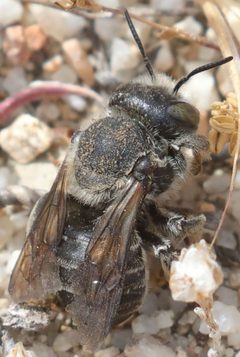
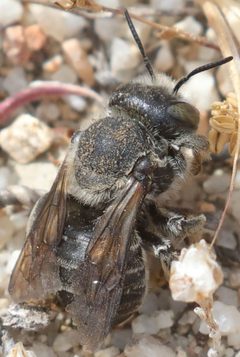
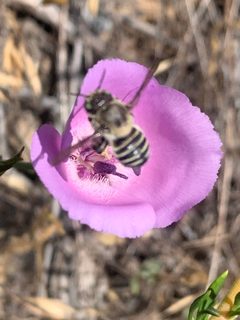
Trachusa perdita is a solitary leafcutting native to California, belonging to the Megachilidae. Females construct underground nests in hillsides, lining with leaves collected from Buckthorn shrubs. The is notable for its distinctive nesting and specific -plant relationship for nest construction materials.
Pronunciation
How to pronounce Trachusa perdita: /ˈtræ.kjuː.sə pərˈdɪt.a/
These audio files are automatically generated. While they are not always 100% accurate, they are a good starting point.
Identification
Distinguished from other Megachilidae by the combination of abdominal scopa, dark grey coloration with white abdominal bands, and nesting involving leaf-lined underground burrows. The only other North American in Trachusa also occurs in California, but T. perdita is specifically associated with Buckthorn leaf use in nest construction. Distinguished from honey bees and bumble bees by solitary lifestyle and abdominal (rather than corbiculate) pollen carriage.
Images
Appearance
Dark grey body with white bands of hairs on the . Scopa (pollen-carrying structure) located on the surface of the abdomen rather than on the legs. Body length ranges from approximately 12–16 mm (one-half to three-eighths of an inch).
Habitat
Semiarid hillsides with shrubbery or tall grass growth. Nests constructed in sloped, well-drained soils allowing for excavation of diagonal tunnels.
Distribution
to California, North America. GBIF records indicate presence in North America and Middle America, though primary range is California.
Diet
feed on nectar. Larvae consume pollen and nectar provisions stored in .
Host Associations
- Buckthorn Shrub - nest materialLeaves used exclusively to line
Life Cycle
Females excavate diagonal tunnels into hillsides, branching into individual . Each cell is lined with Buckthorn leaves, provisioned with nectar and pollen, and receives one . Larval development occurs within the sealed cell.
Behavior
Solitary nesting . Females independently construct and provision underground nests. No social colony structure observed.
Ecological Role
. Contributes to plant through nectar and pollen foraging. Specific ecological role in native California not quantified in available sources.
Human Relevance
Native of potential importance to California and agriculture, though specific crop pollination services not documented. Subject of conservation interest due to native decline trends.
Similar Taxa
- Other Trachusa speciesOnly other North American Trachusa also occurs in California; differentiation requires examination of morphological details and nesting materials
- Megachile leafcutter beesSimilar leaf-using nesting , but Megachile typically nest in pre-existing cavities rather than excavated underground burrows
- Honey bees (Apis mellifera)Both are with abdominal pollen carriage, but honey bees are social, have corbiculae () on hind legs, and use wax rather than leaves for nest construction
More Details
Nesting specificity
Unusual among leafcutting bees for exclusive use of Buckthorn (Rhamnaceae) leaves in nest construction, indicating a specialized foraging relationship with this plant .
Conservation status
trends and specific threats not documented in available literature, though as a native California it may be affected by loss and climate factors affecting other native bees.
Sources and further reading
- BugGuide
- Wikipedia
- GBIF taxonomy match
- iNaturalist taxon
- NCBI Taxonomy
- Catalogue of Life
- Primary Type List | Entomology Research Museum
- You, Too, Can Plant a Pollinator Garden | Bug Squad
- 'Am I Even a Bee?' Identity Crisis Unfolds in This Charming Book | Bug Squad
- Researchers Develop Genome Map for Mojave Poppy Bee
- Bug Eric: World Bee Day....A Little "Bee"hind
- The best species name ever! | Beetles In The Bush