
Pseudoanthidium
Friese, 1898
Small Carder Bees, African Carder Bee (for P. repetitum)
Species Guides
1- Pseudoanthidium nanum(European Small-Woolcarder)
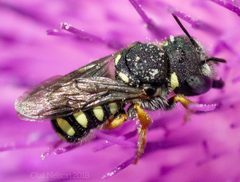
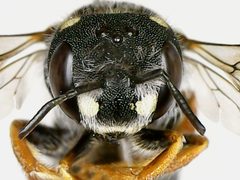
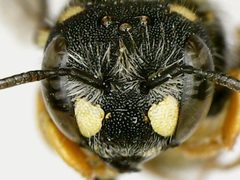
Pseudoanthidium is a of small carder bees in the Megachilidae, first described by Friese in 1898. The genus occurs across Eurasia, Africa, and Australia, with nine recorded in Europe. Some species are cavity-nesters that utilize plant fibers and foreign materials for nest construction. The introduced African (P. repetitum) has established in eastern and Western Australia since 2000 and shows potential for continued range expansion.
Pronunciation
How to pronounce Pseudoanthidium: //ˌsjuːdoʊˈænθɪdiəm//
These audio files are automatically generated. While they are not always 100% accurate, they are a good starting point.
Images
Habitat
European occupy diverse : P. nanum occurs in xerothermic open habitats and nests in reed stalks and oak galls; P. tenellum inhabits terrestrial reed beds and wet meadows with reed galls and Asteraceae flowering plants. In Australia, the introduced P. repetitum has been recorded in residential areas, urban gardens, and coastal regions, with predicted suitable habitat including biodiversity hotspots and world heritage areas.
Distribution
Native range includes Eurasia and Africa. In Europe, nine occur; P. nanum is widespread while P. tenellum is rare throughout its range. In Australia, P. repetitum was first recorded in Queensland in 2000, spread along the eastern coast to Victoria by 2015, and has since been detected in Western Australia (Mandurah region). Current Australian distribution encompasses approximately 332,000 km² concentrated along the eastern coast.
Diet
P. tenellum collects pollen mainly from wetland plants in the Bidens and Pulicaria. P. repetitum is a forager (polylectic), feeding on a wide range of plants from many .
Host Associations
- Xylophrurus augustus - Ichneumonidae, reported from P. nanum
- Stelis punctulatissima - cuckoo beereported from P. tenellum
- Gasteruption nigrescens - -reported from P. tenellum
- Leucospis biguetina - reported from P. tenellum
- Miltogramma punctata - reported from P. tenellum
- Lipara - gall inducerfrit flies; P. tenellum nests in reed galls induced by this
Life Cycle
Nests constructed in pre-existing cavities. P. nanum nests in reed stalks and oak galls. P. tenellum nests inside reed galls induced by Lipara frit flies; nest structure similar to P. nanum. P. repetitum nests in artificial substrates including corrugated cardboard, polystyrene, wood, PVC pipes, and garden hoses, using foreign materials such as synthetic fibers (carpet fluff, clothing lint, curtain fabric) and natural plant fibers.
Behavior
Some are , utilizing galls or cavities constructed by other organisms. P. tenellum is a reed gall inquiline. Nest construction involves collecting and carding plant fibers and other materials to line cavities.
Ecological Role
Pollen collectors; serve as for multiple parasitic including cuckoo bees, -, and . Introduced P. repetitum may alter plant- interactions and compete with native species for food and nesting resources.
Human Relevance
P. repetitum is an introduced in Australia with potential negative impacts on native fauna and flora through competition and alteration. The species has become one of the most common bees in some Australian regions, prompting monitoring efforts.
Similar Taxa
- AnthidiumBoth are carder bees in tribe Anthidiini; Pseudoanthidium was historically classified within Anthidium and shares the of collecting plant fibers for nest construction.
- IcteranthidiumClosely related anthidiine ; the Icteranthidium floripetum was transferred from Pseudoanthidium based on revised classification.
More Details
Taxonomic complexity
The P. scapulare exhibits paraphyly and low genetic divergence among morphologically distinct , suggesting recent divergences and genetic exchange at contact zones. Ten species are recognized in this complex, including two newly described species (P. kaspareki and P. rozeni).
Subgeneric classification
Some are placed in subgenus Immanthidium, including P. repetitum (the African ).
Sources and further reading
- BugGuide
- Wikipedia
- GBIF taxonomy match
- iNaturalist taxon
- NCBI Taxonomy
- Catalogue of Life
- First records of the introduced African carder bee, Pseudoanthidium (Immanthidium) repetitum (Hymenoptera : Megachilidae), in Western Australia
- Nest structure, associated parasites and morphology of mature larvae of two European species of Pseudoanthidium Friese, 1898 (Hymenoptera, Megachilidae)
- Citizen science reveals current distribution, predicted habitat suitability and resource requirements of the introduced African Carder Bee Pseudoanthidium (Immanthidium) repetitum in Australia
- Paraphyly and low levels of genetic divergence in morphologically distinct taxa: revision of the Pseudoanthidium scapulare complex of carder bees (Apoidea: Megachilidae: Anthidiini)
- A survey of megachilid bees of the Nakhchivan Autonomous Republic of Azerbaijan, with description of a new species of Pseudoanthidium Friese, 1898 (Hymenoptera, Megachilidae).