
Dianthidium pudicum
(Cresson, 1879)
Modest Pebble Bee
Species Guides
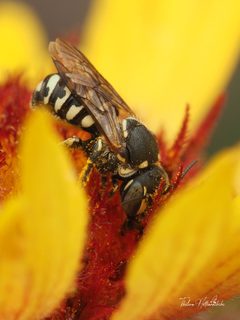
2Dianthidium pudicum, commonly known as the Modest Pebble , is a of resin bee in the Megachilidae. It is native to North America and belongs to a characterized by nesting in pre-existing cavities and using resin to construct and seal nest . Like other Dianthidium species, it is a solitary bee that provisions its nests with pollen and nectar for its offspring. The species has been documented in bee block monitoring studies, indicating its use of artificial nesting structures in urban and suburban environments.
Pronunciation
How to pronounce Dianthidium pudicum: /diænˈθɪdiəm ˈpjuːdɪkəm/
These audio files are automatically generated. While they are not always 100% accurate, they are a good starting point.
Identification
Dianthidium pudicum can be distinguished from other Dianthidium by subtle morphological features, including the specific pattern and extent of pale markings on the body. Within its geographic range, it may be confused with other small megachilid bees such as Heriades or Osmia species. Examination of diagnostic characters including the shape of the , the structure of the , and the specific pattern of punctation on the is typically required for definitive identification. The species is smaller than some and exhibits relatively modest pale markings, consistent with its .
Images
Appearance
As a member of the Dianthidium, this exhibits the typical of resin bees: a compact, somewhat stout body with a broad . The is generally dark with pale or yellowish maculations. Females possess a scopa (pollen-collecting structure) on the underside of the abdomen rather than on the hind legs. The body is moderately hairy, with denser hair on the surface of the abdomen in females for pollen transport.
Habitat
This occupies a variety of open including grasslands, prairies, and open woodlands. It has been documented nesting in blocks and artificial nesting structures, indicating adaptability to human-modified environments. The species requires access to suitable nesting substrates—typically pre-existing cavities such as hollow twigs, borings in dead wood, or artificial tunnels—and sources of resin for nest construction.
Distribution
Dianthidium pudicum is native to North America, with records from the central and western United States. Specific documented localities include Colorado and surrounding regions. The ' range extends through the Great Plains and into the western United States, though precise distributional boundaries remain incompletely documented.
Seasonality
activity has been recorded during the summer months, with observations from June in Colorado. As with other Dianthidium , the period likely extends from late spring through mid-summer, with exact timing varying by latitude and elevation.
Life Cycle
Females utilize pre-existing cavities such as hollow twigs, borings in dead wood, or artificial tunnels in blocks for nesting. They construct individual within these cavities, partitioning them with walls made of collected resin. Each cell is provisioned with a pollen-nectar mixture () before an is laid. The larva consumes the provision, spins a cocoon, and pupates within the cell. Development time from egg to is approximately several weeks under favorable conditions, with some individuals potentially entering to overwinter as or pupae.
Behavior
This is a solitary with no social organization. Females are responsible for all nest construction, provisioning, and oviposition. They collect resin from plant sources to construct partitions and nest plugs. The species has been observed nesting in when suitable nesting sites are abundant. Males are typically smaller than females and do not participate in nest construction or provisioning.
Ecological Role
As a solitary , D. pudicum serves as a of flowering plants within its . Its specific floral associations are not well documented, but like other Dianthidium , it likely visits a variety of open flowers. The species also serves as a for parasitic , including leucospid wasps in the Leucospidae, which are known to parasitize megachilid bees.
Human Relevance
This has been documented utilizing artificial blocks or bee hotels, indicating its value as a subject for native bee conservation and citizen science monitoring. Its presence in urban and suburban environments demonstrates the potential for providing artificial nesting structures to support native . The species contributes to pollination services in both natural and human-modified landscapes.
Similar Taxa
- Dianthidium (Dianthidium) spp.Other in the subgenus Dianthidium share similar and nesting habits, requiring careful examination of specific diagnostic characters for separation.
- Heriades spp.These small megachilid bees also nest in pre-existing cavities and use resin for nest construction, though they typically have more elongate bodies and different facial markings.
- Osmia spp.Mason bees in this are similar in size and nesting but typically use mud or chewed leaf material rather than resin for nest partitions.
More Details
Nesting biology
A comment on the Eric blog from June 2016 noted that Dianthidium was observed nesting in a box at a nature park in Texas, confirming the ' use of artificial nesting structures.
Parasitism
As a megachilid , D. pudicum is likely subject to by leucospid wasps ( Leucospidae), which are documented of Dianthidium and related . The most common North American , Leucospis affinis, is known to parasitize Dianthidium nests.