
Anthidium palliventre
Cresson, 1878
Pacific Woolcarder
Anthidium palliventre is a megachilid native to western North America, commonly known as the Pacific Woolcarder. Females collect plant fibers, particularly from hairy leaves such as lamb's ears (Stachys byzantina), to construct nest . Males establish and defend floral territories, exhibiting aggressive toward other insects that approach their claimed flowers. The is closely related to the introduced European wool carder bee (Anthidium manicatum), but is native rather than .
Pronunciation
How to pronounce Anthidium palliventre: /ænˈθɪdiəm ˌpælɪˈvɛntri/
These audio files are automatically generated. While they are not always 100% accurate, they are a good starting point.
Identification
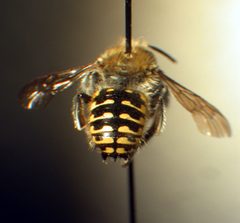
Distinguished from the similar European wool carder bee (Anthidium manicatum) by its native western North American distribution. The specific epithet 'palliventre' refers to the pale or pallid . Females possess scopae (pollen-collecting hairs) on the underside of the abdomen rather than on the hind legs, a characteristic feature of Megachilidae. Males have multiple sharp spines on the abdomen, which they use in territorial combat with other males.
Images
Distribution
Western North America, including California and adjacent regions. Distribution records indicate presence in Middle America and North America.
Host Associations
- Stachys byzantina - fiber source for nest constructionFemales scrape or 'card' the hairy leaves to collect nesting fibers
Behavior
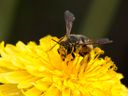
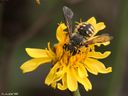
Females construct nests using plant fibers collected from hairy leaves, a known as 'carding.' Males are highly territorial, establishing and defending specific floral patches against intruders including other . Territorial males patrol flowers from dawn to dusk, allowing access only to females of their own species for mating and resource collection.
Ecological Role
that visits flowers for nectar and pollen. Contributes to native diversity in western North American .
Human Relevance
Native that has been observed in -friendly gardens and conservation areas. Less well-known than its introduced relative Anthidium manicatum, with which it shares similar nesting .
Similar Taxa
- Anthidium manicatumEuropean wool carder bee; introduced to North America with similar male territorial and female fiber-collecting habits, but distinguished by its non-native status and eastern/wider distribution
- Anthidium pallidiventreSynonym; emended spelling of the same
- Anthidium californicumSynonym; originally described as a separate but now synonymized with A. palliventre
More Details
Taxonomic History
Originally described by Cresson in 1878. The has undergone several taxonomic revisions, with Anthidium californicum and Anthidium palliventre vanduzeei subsequently synonymized. The spelling Anthidium pallidiventre was an emendation by Dalla Torre in 1896.
Sources and further reading
- BugGuide
- Wikipedia
- GBIF taxonomy match
- iNaturalist taxon
- Catalogue of Life
- Not a Terrorist | Bug Squad
- The Wonderful World of Insects | Bug Squad
- Primary Type List | Entomology Research Museum
- The Bee Team Visits the Haven | Bug Squad
- UC Davis: All A'Buzz With Bee Nests and Art | Bug Squad
- A Moth Like No Other: Neopalpa donaldtrumpi | Bug Squad