
Anthidium oblongatum
(Illiger, 1806)
oblong woolcarder bee
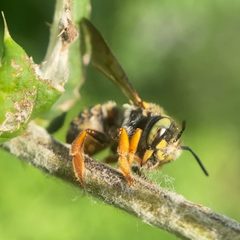
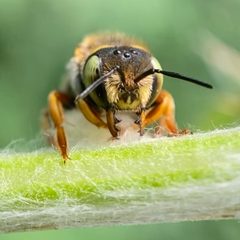
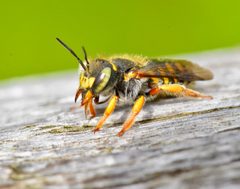
Anthidium oblongatum is a solitary in the Megachilidae, commonly known as the oblong woolcarder bee. Native to Eurasia and North Africa, it has been introduced to North America and South America, with a first record in central Chile documented in 2025. Females construct nests using plant fibers collected from leaves, earning the 'woolcarder' . The shows strong floral specialization, primarily foraging on Fabaceae, Crassulaceae, and Resedaceae.
Pronunciation
How to pronounce Anthidium oblongatum: //ænˈθɪdiəm ˌɒblɒŋˈɡætəm//
These audio files are automatically generated. While they are not always 100% accurate, they are a good starting point.
Identification
Distinguished from the related European woolcarder (Anthidium manicatum) by its more slender, oblong body shape and less robust build. The specific epithet 'oblongatum' refers to this elongated body form. Females possess specialized scopal hairs on the underside of the for carrying pollen, characteristic of Megachilidae. Males may be distinguished by territorial and territorial markings, though specific diagnostic features require close morphological examination.
Images
Habitat
Warm, dry locations including flowering grasslands, hedges, and dry stone walls. Occupies sites such as weathering heaps, road embankments, railway embankments, and flood dams. Found in urban and suburban areas including flowering areas and rock gardens. Nesting sites are often spatially separated from pollen sources. Occurs from lowlands to montane elevations.
Distribution
Native to Eurasia from Portugal across southern, central and eastern Europe through Ukraine, southern Russia and Siberia (east to Tuva), and via Asia Minor, the Caucasus to the Central Asian mountains. European range extends north to the Netherlands, Brandenburg, central Poland and Belarus; south to Sicily, Thessaly, Iran and Afghanistan. Also native to Morocco. Introduced to North America, first detected in the eastern United States in 1995, now established throughout northeastern North America, Colorado, Utah, and the Pacific Northwest. First recorded in South America in central Chile in 2025.
Seasonality
period occurs in one from mid-June to early August.
Diet
Pollen and nectar. Shows strong floral specialization, collecting pollen almost exclusively from Fabaceae (especially Lotus and Onobrychis species, with Lotus corniculatus and Onobrychis viciifolia preferred), Crassulaceae (especially Sempervivum species and Sedum species, with Sedum reflexum preferred), and Resedaceae.
Host Associations
- Lotus corniculatus - food plantpreferred pollen source
- Onobrychis viciifolia - food plantpreferred pollen source
- Sedum reflexum - food plantpreferred pollen source
- Stelis punctulatissima - cuckoo bee , documented in France
- Chrysis marginata - cuckoo wasp , likely based on observations from Germany and Switzerland
Life Cycle
, with one per year. Nests in pre-existing cavities, preferring horizontal crevices 5–6 mm wide in dry stone walls and weathered slate rocks. are constructed from plant fibers (vegetable wool) collected from leaves. The outside of the nest is marked with rust-colored glandular secretions.
Behavior
Females use their to scrape or 'card' plant fibers from hairy leaves to construct nest . Males are territorial and patrol territories around flowering plants. Nesting sites are often spatially separated from foraging areas for pollen and building materials.
Ecological Role
Human Relevance
Has been introduced to North America and South America, with potential ecological impacts through competition with native bees and disruption of local pollination networks. Populates gardens where suitable food plants and nesting materials are available.
Similar Taxa
- Anthidium manicatumBoth are woolcarder bees in the same with similar nesting using plant fibers; A. oblongatum is more slender/oblong in body shape and has different floral associations
- Anthidium florentinumOverlapping distribution and similar preferences in Europe; requires morphological examination for reliable separation
More Details
Nesting biology
Unlike some cavity-nesting bees that excavate their own burrows, A. oblongatum is an obligate cavity nester that relies on pre-existing spaces. The has been observed using passage-like cavities in buildings, similar to Anthidium manicatum.
Recent range expansion
The 2025 record from Chile represents a significant range expansion into South America, documented through citizen science platforms and field-collected specimens. This follows earlier introductions to North America.
Sources and further reading
- BugGuide
- Wikipedia
- GBIF taxonomy match
- iNaturalist taxon
- NCBI Taxonomy
- Catalogue of Life
- Not a Terrorist | Bug Squad
- The Wonderful World of Insects | Bug Squad
- Primary Type List | Entomology Research Museum
- The Bee Team Visits the Haven | Bug Squad
- UC Davis: All A'Buzz With Bee Nests and Art | Bug Squad
- A Moth Like No Other: Neopalpa donaldtrumpi | Bug Squad
- Two new records of exotic bees in Chile: Osmia niveata (Fabricius, 1804) and Anthidium oblongatum (Illiger, 1806) (Hymenoptera: Megachilidae), with notes on their distribution and ecological interactions