
Anthidium florentinum
(Fabricius, 1775)
Florentine Woolcarder Bee, European wool carder bee
Anthidium florentinum is a medium to large solitary in the Megachilidae, commonly known as the Florentine wool carder bee. Native to the Mediterranean region, it has been introduced to multiple continents including North America, South America, Africa, and Asia. Males are highly territorial and defend floral resources against conspecifics and other bees. Females collect plant trichomes (wool) to line nest constructed in pre-existing cavities. The has been detected in the Canary Islands through citizen science, representing a recent range expansion to oceanic archipelagos.
Pronunciation
How to pronounce Anthidium florentinum: /ænˈθɪdiəm flɔːˈrɛntɪnəm/
These audio files are automatically generated. While they are not always 100% accurate, they are a good starting point.
Identification
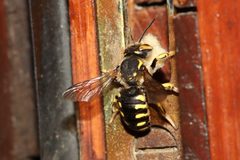
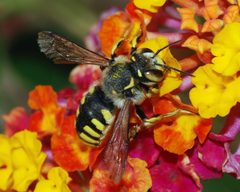
Distinguished from similar Anthidium by the two yellow bands on each tergite combined with male-specific grey/whitish lateral abdominal hairs. Differs from Anthidium manicatum (European wool carder bee) in banding pattern and hair coloration. Female A. florentinum has pale yellowish rather than bright yellow or orange scopa. Territorial male and resource defense can aid field identification. In the Canary Islands, it represents a new record distinguishable from native Megachilidae by its banded and wool-gathering behavior.
Images
Appearance
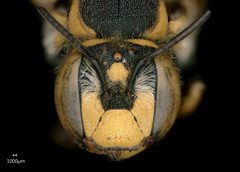
Medium to large with black bearing two yellow bands on each tergite. Males distinguished by grey to whitish hairs on sides of abdomen and are larger than females. Females possess pale yellowish pollen brushes (scopa) on underside of abdomen. Both sexes have robust body form typical of wool carder bees.
Habitat
Occupies urban and suburban environments, cities, and areas with suitable nesting substrates. Nests in pre-existing cavities including hollow stems, wall crevices, and abandoned nests of other insects. Requires access to plants with trichome-rich leaves for female nest construction. Floral territories established by males typically around patches of nectar and pollen sources.
Distribution
Native to Mediterranean region of Europe and Northern Africa. Introduced and established in North America, South America, Asia, North Africa, and the Canary Islands. In the United States, occur in alfalfa-growing regions where it has been evaluated as a . Recent records from Tenerife and Gran Canaria represent first documented occurrence in the Macaronesian archipelago.
Seasonality
season with overlapping male and female activity periods, unlike most solitary bees where males emerge earlier and disappear before females. Active during warm months when floral resources are available; specific timing varies by region.
Life Cycle
Nests constructed in pre-existing cavities such as hollow stems, wall holes, or abandoned insect nests. Females line nest with chewed plant fibers (wool) collected from trichome-rich leaves. Detailed developmental stages and not documented in available sources.
Behavior
Males establish and aggressively defend territories around floral resources against males and other including honey bees. Territorial defense involves aerial pursuit and physical grappling. Females collect plant trichomes by scraping hairy leaves with their to obtain nest-lining material. Both sexes visit flowers for nectar; females additionally collect pollen. Mating occurs on vegetation rather than in .
Ecological Role
of flowering plants including alfalfa; has been observed to be more efficient than native for alfalfa pollination in some contexts. As an species in introduced ranges including the Canary Islands, may compete with native bees for floral and nesting resources. Male territoriality can influence local bee dynamics through interference competition.
Human Relevance
Evaluated as an efficient of alfalfa in agricultural settings. Subject of citizen science detection through platforms like iNaturalist, contributing to early detection of spread. Occasionally mistaken for aggressive '' due to male territorial , though actual threat to honey bees is minor compared to other and environmental factors. Used in educational contexts to demonstrate nesting behaviors and territoriality.
Similar Taxa
- Anthidium manicatumAlso a European wool carder bee with male territoriality and wool-gathering females; differs in abdominal banding pattern, male hair coloration, and female scopa color
- Other Anthidium speciesShare wool carding and cavity-nesting habits; distinguished by specific banding patterns, body size, and hair coloration
Misconceptions
Male territorial attacks on other bees have been exaggerated in media reports as representing a serious threat to honey bees and agricultural pollination. Actual impact on is minimal compared to other sources of mortality. Not a '' (Africanized honey bee) or major agricultural pest.
More Details
Citizen science detection
First records in the Canary Islands were detected through iNaturalist observations, demonstrating the value of biodiversity inventorying platforms for early detection of in oceanic archipelagos.
Sexual dimorphism reversal
Unlike most solitary bees where females are larger, A. florentinum shows reversed sexual size dimorphism with males larger than females, associated with prolonged female sexual receptivity and male territorial resource defense.
Sources and further reading
- BugGuide
- Wikipedia
- GBIF taxonomy match
- iNaturalist taxon
- NCBI Taxonomy
- Catalogue of Life
- Not a Terrorist | Bug Squad
- The Wonderful World of Insects | Bug Squad
- Primary Type List | Entomology Research Museum
- The Bee Team Visits the Haven | Bug Squad
- UC Davis: All A'Buzz With Bee Nests and Art | Bug Squad
- A Moth Like No Other: Neopalpa donaldtrumpi | Bug Squad
- Phenology of two territorial solitary bees, Anthidium manicatum and A. florentinum (Hymenoptera: Megachilidae)
- First records of Anthidium florentinum (Hymenoptera, Megachilidae) in the Canary Islands: insights on citizen science and exotic bee species
- Nesting behavior of the wool carder bee Anthidium florentinum (Fabricius, 1775) (Hymenoptera; Megachilidae) in artificial nests in the region of Constantine