
Odontocolon ochropus
Townes, 1960
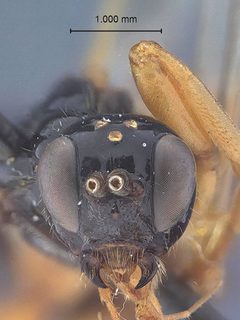
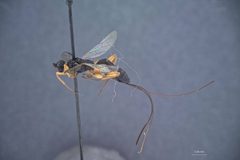
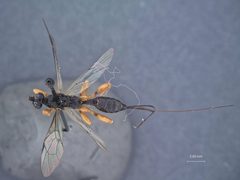
Odontocolon ochropus is a of ichneumon in the Xoridinae, described by Townes in 1960. Like other members of its , it is a of wood-boring beetles, utilizing its long ovipositor to reach concealed within dead or dying wood. The species belongs to a group of 23 Odontocolon species found north of Mexico, several of which have holarctic distributions spanning the entire northern hemisphere.
Pronunciation
How to pronounce Odontocolon ochropus: //oʊˌdɒn.toʊˈkɒ.lɒn ˈɒk.roʊˌpʊs//
These audio files are automatically generated. While they are not always 100% accurate, they are a good starting point.
Identification
Distinguished from other ichneumon wasps by the toothed hind characteristic of the Odontocolon. Females are further identified by their long ovipositor, contrasting with the shorter of males. Separation from the 22 other Odontocolon north of Mexico requires examination of detailed morphological characters not specified in general sources. The Xoridinae can be distinguished from other ichneumonid subfamilies by its specialized association with wood-boring .
Images
Habitat
Associated with dead and dying hardwood trees, particularly stumps and fallen timber where wood-boring larvae are active. Most frequently encountered in autumn when -seeking females investigate recently dead wood.
Distribution
North America; precise range within the continent is not documented for this specifically. The Odontocolon includes several holarctic species with trans-hemispheric northern distributions, though O. ochropus itself has not been confirmed as holarctic.
Seasonality
are most active in autumn, coinciding with the availability of wood-boring in dead and dying trees.
Host Associations
- Cerambycidae - Longhorned wood-boring larvae are the primary . Females oviposit on living beetle or pupae concealed within wood.
Life Cycle
Female drills into wood with her ovipositor and deposits an on or near a living or pupa. The larva hatches and develops as an external , feeding on the while it matures. The wasp larva eventually consumes the host entirely and emerges from the host's pupa. Development timing is tied to that of the wood-boring host, with typically occurring when the host would normally pupate.
Behavior
Females methodically search dead wood surfaces, tapping with and probing with the ovipositor to locate concealed . When a suitable host is detected, the female drills through wood to reach it. ignore exposed, unprotected , preferring hosts still concealed within their galleries. This selectivity may reflect an avoidance of hosts vulnerable to or desiccation before the can complete development.
Ecological Role
Acts as a agent of wood-boring beetles, regulating of Cerambycidae and potentially other insects. Contributes to nutrient cycling in forest by accelerating the breakdown of wood through mortality.
Human Relevance
No direct economic significance documented. Indirectly beneficial through suppression of wood-boring in forests and urban trees.
Similar Taxa
- MegarhyssaAlso large ichneumon wasps with extremely long ovipositors adapted for reaching wood-boring . Distinguished by lacking the toothed hind of Odontocolon and belonging to a different (Rhyssinae versus Xoridinae).
- Other Xoridinae generaThree additional in the share the lifestyle on wood-borers. These require detailed morphological examination for separation from Odontocolon.
More Details
Taxonomic context
Odontocolon is one of four in the Xoridinae. The genus comprises 23 north of Mexico, with O. ochropus described by Townes in 1960 based on morphological characters.
Collection notes
Specimens are most readily collected by investigating dead and dying hardwood trees, particularly maple stumps and logs, during autumn months when females are actively searching for .