
Tryphon seminiger
Cresson, 1864
Tryphon seminiger is a of ichneumon in the Tryphoninae. It is a koinobiont ectoparasitoid, meaning its larva feeds externally on a living that continues to develop until the wasp completes its development. The species has been recorded in central Canada (Saskatchewan, Alberta) based on GBIF distribution data. As a member of Tryphoninae, it likely shares traits with related species in the , including activity and attraction to artificial lights.
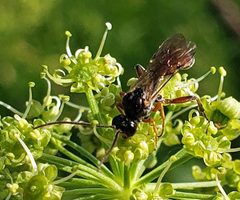
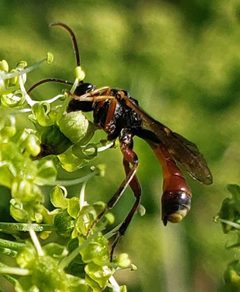
Pronunciation
How to pronounce Tryphon seminiger: /ˈtrɪfɒn ˌsɛmɪˈnʌɪdʒə/
These audio files are automatically generated. While they are not always 100% accurate, they are a good starting point.
Images
Distribution
Recorded from central Canada: Fawcett, Alberta; Nipawin and Saskatoon, Saskatchewan. The Tryphon is primarily Holarctic in distribution.
Ecological Role
As a koinobiont ectoparasitoid, the larva likely functions as a agent of its . Tryphon are known to parasitize larvae (Hymenoptera: ), though the specific host of T. seminiger has not been documented.
Similar Taxa
- Netelia speciesAlso in Tryphoninae, Netelia are frequently confused with Tryphon due to similar orange coloration, , and attraction to lights. Netelia females possess a longer ovipositor relative to body size and can deliver a painful sting when handled.
- Ophion speciesMembers of Ophioninae are often uniformly orange with large ocelli and habits, but lack the prominent ovipositor seen in Tryphoninae and have different wing venation.
More Details
Data limitations
Very little -specific information is available for T. seminiger. Most knowledge of Tryphon derives from studies of congeneric species, particularly T. notatus and related European species. The 11 iNaturalist observations suggest it is rarely encountered or underreported.
Taxonomic note
Tryphon is a large with over 100 described , many of which are poorly known biologically. Species identification typically requires examination of wing venation, propodeal , and male genitalia.