
Netelia
Gray, 1860
Orange Ichneumon Wasp, Netelia Wasp
Species Guides
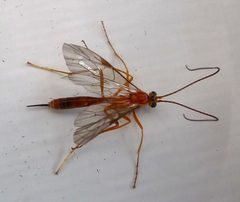
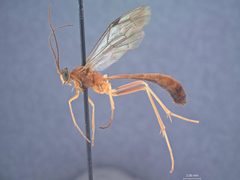
2Netelia is a large of ichneumonid wasps in the Tryphoninae, comprising over 330 described grouped into 12 subgenera. These medium to large are typically orange to brownish-yellow in coloration with conspicuously long and legs. Females possess a prominent ovipositor used to parasitize caterpillar . Unlike many ichneumonids, Netelia females can deliver a painful sting when handled carelessly, using it to temporarily paralyze hosts before deposition. The genus is in distribution and frequently attracted to artificial lights at night.
Pronunciation
How to pronounce Netelia: /nɛˈtɛliə/
These audio files are automatically generated. While they are not always 100% accurate, they are a good starting point.
Images
Appearance
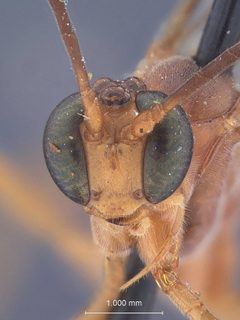
Medium to large ichneumonid wasps, entirely orange to brownish-yellow in coloration. Fore wing length ranges from 6–20 mm. and legs are conspicuously long relative to body size. Large ocelli often touch the . twisted 90°. Prominent ovipositor present in females, ranging from 0.3 to 0.7 times the length of the hind tibia. Forewing with 2r-m and 3r-m present; 3r-m forms a small triangular areolet; Rs vein strongly bent as it approaches 3r-m.
Host Associations
- Xanthorhoe fluctuata (Garden Carpet) - Specific for N. inedita
- Lithostege griseata (Grey Carpet) - Specific for N. inedita
- Geometridae (Larentiinae) - Larval for N. inedita
- Helicoverpa spp. - for N. producta in Australia
Similar Taxa
- OphioninaeSuperficially similar orange ichneumonids with long and large ocelli, but distinguished by forewing venation: Ophioninae lack the small triangular areolet formed by 3r-m and have different Rs structure; also possess very short or absent ovipositor versus prominent ovipositor in Netelia
- EnicospilusSimilar orange ichneumonids attracted to lights; distinguished by wing venation details and genitalia structure
- Crane flies (Tipulidae)Mistaken identity due to long legs and erratic ; crane flies lack stinger/ovipositor, have different wing structure, and cannot sting
Sources and further reading
- BugGuide
- Wikipedia
- GBIF taxonomy match
- iNaturalist taxon
- NCBI Taxonomy
- Catalogue of Life
- Bug Eric: Wasp Wednesday: Netelia
- Bug Eric: City Nature Challenge 2023 Recap
- The genome sequence of a parasitoid wasp, Netelia inedita (Kokujev, 1899) (Hymenoptera: Ichneumonidae)
- Peer Review Report For: The genome sequence of a parasitoid wasp, Netelia inedita (Kokujev, 1899) (Hymenoptera: Ichneumonidae) [version 1; peer review: 1 approved]
- Peer Review Report For: The genome sequence of a parasitoid wasp, Netelia inedita (Kokujev, 1899) (Hymenoptera: Ichneumonidae) [version 1; peer review: 1 approved, 1 approved with reservations]
- Peer Review Report For: The genome sequence of a parasitoid wasp, Netelia inedita (Kokujev, 1899) (Hymenoptera: Ichneumonidae) [version 1; peer review: 2 approved, 1 approved with reservations]
- Mass rearing of two larval parasitoids of Helicoverpa spp. (Lepidoptera: Noctuidae): Netelia producta (Brullé) and Heteropelma scaposum (Morley) (Hymenoptera: Ichneumonidae) for field release
- The genome sequence of an ichneumonid wasp, Netelia melanura (Thomson, 1888) (Hymenoptera: Ichneumonidae).
- The genome sequence of an ichneumonid wasp, Netelia fuscicornis (Holmgren, 1860).