
Megarhyssa macrurus icterosticta
Megarhyssa macrurus icterosticta is a of giant ichneumon wasp, among the largest ichneumonids in North America. Males of this subspecies are smaller than those of the sympatric M. atrata, with more brown than black body coloration and wings that are clear with a well-developed spot on the costal margin. Females possess extremely long ovipositors used to parasitize woodboring larvae of Tremex columba (pigeon horntail) in decaying hardwoods, particularly at shallower depths than those reached by larger .
Pronunciation
How to pronounce Megarhyssa macrurus icterosticta: //mɛɡəˈrɪsə mæˈkruːrəs ˌɪktɛroʊˈstɪktə//
These audio files are automatically generated. While they are not always 100% accurate, they are a good starting point.
Identification
Distinguished from M. atrata by smaller male size, more brown than black body coloration, and clear wings with well-developed costal spot (versus smoky wings with narrow spot in M. atrata). Females distinguished by ovipositor length relative to body and depth of wood penetration during oviposition; M. macrurus females target shallower horntail larvae than M. atrata.
Images
Appearance
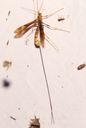
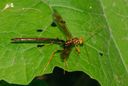
Medium to large ichneumon . Males: body predominantly brown with black markings, wings clear with well-developed dark spot on costal margin. Females: extremely long, thread-like ovipositor (often exceeding body length), body coloration similar to males. Smaller overall than M. atrata males, which have more extensive black coloration and smoky wings with narrow costal spot.
Habitat
Deciduous forests with declining or dead hardwood trees, particularly sugar maple (Acer saccharum) and other supporting Tremex columba . Requires standing dead or dying wood with intact bark for oviposition substrate.
Distribution
Eastern North America; documented in Missouri and surrounding regions. Exact range boundaries relative to nominate undetermined from available sources.
Seasonality
activity observed in spring; specific period not documented in sources.
Host Associations
- Tremex columba - Larval of woodboring pigeon horntail larvae; females target larvae at shallower depths in wood than M. atrata
Behavior
Males exhibit 'tergal stroking' : bending forward beneath body and rubbing abdominal tip against bark, sometimes inserting tip into bark cracks. Males aggregate on tree trunks where females are emerging or ovipositing. Function of tergal stroking unknown; possibly related to sex discrimination of emerging or increasing encounter rate with virgin females.
Ecological Role
Primary regulating of Tremex columba. Coexists with larger M. atrata through resource partitioning: M. macrurus females parasitize horntail larvae at shallower wood depths, while M. atrata females access deeper larvae with longer ovipositors.
Similar Taxa
- Megarhyssa atrataSympatric with larger males (more black, smoky wings with narrow costal spot), larger females with longer ovipositors targeting deeper horntail larvae; both aggregate at same trees but partition resources by depth
More Details
Resource partitioning
Co-occurrence of M. macrurus and M. atrata at the same trees represents apparent exception to competitive exclusion principle, enabled by size-based ovipositor length differences creating vertical stratification of access to horntail larvae
Male aggregation behavior
Previously hypothesized to function in early insemination of unemerged females; current evidence suggests role in sex discrimination or mate location