
Megarhyssa atrata
(Fabricius, 1781)
Black Giant Ichneumonid Wasp
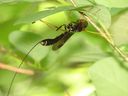
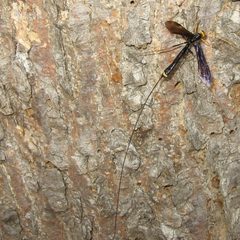
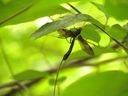
Megarhyssa atrata is the largest known hymenopteran , with females possessing an ovipositor that can exceed 130 mm—longer than any other genital apparatus. The is primarily black with a yellow and legs, and lacks the reddish-orange markings found in . It parasitizes the larvae of the pigeon horntail (Tremex columba) deep within decaying hardwood, using remarkable wood-penetrating adaptations. Males aggregate at sites and exhibit distinctive "tergal stroking" , rubbing their tips against bark.
Pronunciation
How to pronounce Megarhyssa atrata: //ˌmɛɡəˈrɪsə əˈtreɪtə//
These audio files are automatically generated. While they are not always 100% accurate, they are a good starting point.
Identification
Megarhyssa atrata is distinguished from by its predominantly black body coloration with yellow restricted to the and legs; M. macrurus and M. nortoni typically show extensive reddish-orange markings on the and . Females are larger than males and possess a longer ovipositor relative to body size. Males have clear wings with a well-developed spot on the costal margin, while females have smoky wings with only a narrow costal spot. The is noticeably larger than M. macrurus when both occur sympatrically.
Images
Habitat
Found in association with dead, dying, or decaying hardwood trees—particularly maple, beech, and other deciduous —where horntail larvae have established. Requires wood in sufficient decay to allow ovipositor penetration, though females can secrete cellulase to soften wood during drilling.
Distribution
Eastern North America from Quebec and Ontario south through the Great Lakes region to Florida, and west to at least Texas. Records from Manitoba and Oklahoma suggest broader distribution in central North America.
Seasonality
active from May through July, with peak varying by latitude.
Host Associations
- Tremex columba - Larvae parasitize horntail larvae tunneling in dead hardwood; females can reach deeper chambers than M. macrurus due to longer ovipositor
Life Cycle
Females deposit on or near horntail larvae deep within wood using an ovipositor that may exceed 130 mm. Larvae are ectoparasitoids, attaching to larvae and consuming them after the host reaches near-mature size. occurs within the wood; emerge the following year.
Behavior
Males aggregate at sites where females are about to emerge, engaging in "tergal stroking"—bending the forward to rub the tip against bark and insert it into crevices. This is thought to facilitate sex discrimination of emerging or increase encounter rates with virgin females. Females drill into wood while secreting cellulase to break down woody tissue, allowing ovipositor insertion.
Ecological Role
Kleptoparasitoid of wood-boring insects; of Tremex columba. Coexists with M. macrurus through resource partitioning by ovipositor length—M. atrata accesses deeper chambers inaccessible to smaller .
Human Relevance
Harmless to humans despite formidable appearance; ovipositor cannot sting. Occasionally encountered in residential areas when dead trees are present, sometimes causing alarm due to size and long "tail." Subject of scientific interest due to extreme morphological specialization.
Similar Taxa
- Megarhyssa macrurusSmaller size, extensive reddish-orange thoracic and abdominal markings, shorter ovipositor; males have clear wings with well-developed costal spot versus smoky wings in M. atrata males
- Megarhyssa nortoniIntroduced to New Zealand and other regions for ; similar size range but coloration and distribution differ
- Tremex columba , often mistaken for the ichneumon; has a short, spine-like ovipositor (not a stinger) and cylindrical body form
Sources and further reading
- BugGuide
- Wikipedia
- GBIF taxonomy match
- iNaturalist taxon
- NCBI Taxonomy
- Catalogue of Life
- What a Wasp! What a Tattoo! | Bug Squad
- Hymenoptera | Beetles In The Bush | Page 4
- Bug Eric: Giant ichneumon wasps
- STRUCTURE, SENSORY EQUIPMENT, AND SECRETIONS OF THE OVIPOSITOR IN A GIANT SPECIES OF HYMENOPTERA: MEGARHYSSA ATRATA F. (ICHNEUMONIDAE, PIMPLINAE)