
Gelis tenellus
(Say, 1835)
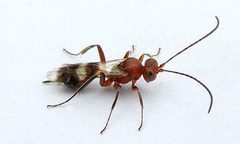
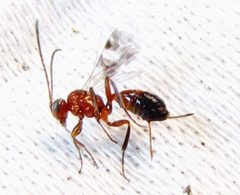
Gelis tenellus is a hyperparasitoid in the Ichneumonidae. It attacks Apanteles melanoscelus, a braconid of the gypsy moth (Lymantria dispar), placing it at the fourth in forest . The exhibits sophisticated discrimination , capable of distinguishing between parasitized and unparasitized host larvae. Females locate host cocoons on tree trunks and use their elongated ovipositors to drill through cocoon walls to deposit . The species undergoes induced by and temperature cues, an for seasonal survival.
Pronunciation
How to pronounce Gelis tenellus: //ˈɡɛ.lɪs tɛˈnɛl.ləs//
These audio files are automatically generated. While they are not always 100% accurate, they are a good starting point.
Images
Habitat
Associated with tree trunks where cocoons of Apanteles melanoscelus are located; linked to gypsy moth in forest .
Distribution
Recorded from Swan River, Canada; Winnipeg, Canada; and Hawaii, United States.
Host Associations
- Apanteles melanoscelus - primary Braconid of gypsy moth; G. tenellus attacks its cocoons
- Lymantria dispar - indirectGypsy moth; of A. melanoscelus
Behavior
Females exhibit discrimination, preferentially attacking cocoons containing A. melanoscelus over unparasitized hosts. Searching is concentrated on tree trunks where host cocoons occur. Host assessment involves antennal tapping, drilling attempts with the ovipositor, and extended time investment on suitable hosts. Oviposition requires drilling through the host cocoon wall. The undergoes , with induction triggered by and temperature environmental cues.
Ecological Role
Hyperparasitoid functioning as a fourth consumer, attacking a primary of an herbivorous insect. This trophic position contributes to complex dynamics in forest and may influence of gypsy moth through effects on its primary parasitoid.
More Details
Taxonomic history
Originally described as Cryptus tenellus by Say in 1835, later transferred to Gelis. NCBI lists authority as (Say, 1836), reflecting minor discrepancies in citation dating.
Research significance
Studied as a model for hyperparasitoid discrimination and physiology, contributing to understanding of multitrophic interactions in systems.
Sources and further reading
- BugGuide
- GBIF taxonomy match
- iNaturalist taxon
- NCBI Taxonomy
- Catalogue of Life
- Jill Oberski: Why Museum Collections Matter | Bug Squad
- Publications | Entomology Research Museum
- Bug Eric: Compost Insects
- Uncategorized | Blog - Part 42
- Survival of the fittest: predator wasps breed at the expense of spider juveniles | Blog
- An Evening at Silent Valley - Buglife Blog - Buglife
- Notes on the Biology and Diapause Inducement of the Hyperparasite Gelis tenellus
- Host Discrimination and Host Acceptance Behavior of Gelis tenellus , a Hyperparasite of Apanteles melanoscelus