
Enicospilus flavostigma
Hooker, 1912
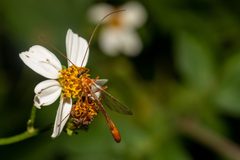
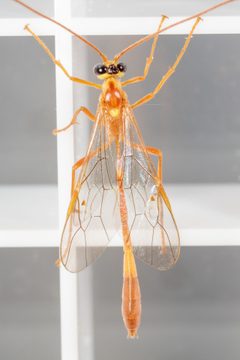
Enicospilus flavostigma is a of ichneumon in the Ophioninae, first described by Hooker in 1912. Like other members of its , it is a wasp with a uniformly orange or reddish-orange coloration. The species belongs to a group of large, gangly ichneumon wasps characterized by long , prominent ocelli arranged in a triangle on the , and reduced or very short ovipositors. Enicospilus species are koinobiont ectoparasitoids of lepidopteran larvae.
Pronunciation
How to pronounce Enicospilus flavostigma: /ɛnɪˈkɒspɪləs ˌfleɪvoʊˈstɪɡmə/
These audio files are automatically generated. While they are not always 100% accurate, they are a good starting point.
Identification
Distinguished from similar orange ichneumon wasps in the Netelia ( Tryphoninae) by its shorter ovipositor and generally larger size. Netelia females possess a noticeably longer ovipositor used to puncture caterpillar and lay stalked . Enicospilus can be separated from other Ophioninae genera by wing venation patterns and details of the ocellar arrangement. Identification to level requires examination of wing venation and other minute morphological features.
Images
Habitat
Found in varied terrestrial where lepidopteran are present. are frequently observed at artificial light sources at night. The likely inhabits open woodlands, forest edges, and agricultural areas where host caterpillars feed.
Distribution
Recorded from Brazil (states of Bahia, Minas Gerais, Mato Grosso, Rio de Janeiro, Rio Grande do Norte, Santa Catarina, and São Paulo). The Enicospilus has a distribution with many found across multiple continents.
Seasonality
are active year-round in tropical regions. activity peaks during warmer months when caterpillars are abundant.
Host Associations
- Lepidoptera - Larvae are koinobiont ectoparasitoids of caterpillars
Life Cycle
Females locate caterpillar and lay externally. The larva hatches and remains attached to its egg stalk via specialized bristles, feeding on the host as an external without arresting its development (koinobiosis). The host caterpillar continues to grow and feed normally while the wasp larva develops. occurs outside the host or in the soil.
Behavior
Strictly . are strongly attracted to artificial light sources, often appearing at porch lights and indoor lighting. is somewhat erratic and bouncing. When disturbed or trapped against skin or clothing, females may sting defensively. The sting is painful but not medically significant for most people.
Ecological Role
agent regulating of and caterpillars. As a koinobiont ectoparasitoid, it allows development to continue while consuming the host, potentially reducing damage to vegetation by preventing caterpillars from reaching reproductive maturity.
Human Relevance
Occasional nuisance when attracted to outdoor and indoor lighting. Females can deliver a painful sting if handled carelessly or trapped against skin. Multiple anecdotal reports document unprovoked stinging incidents, particularly when enter homes and contact sleeping humans. Not known to cause severe allergic reactions in most individuals, though localized pain and swelling are common. No nest-building or colonial ; individual wasps do not represent an .
Similar Taxa
- NeteliaSimilar orange coloration and light-seeking , but Netelia has a conspicuously longer ovipositor and belongs to Tryphoninae
- Other Ophioninae generaShare short ovipositor and habits but differ in wing venation, ocellar details, and body proportions
More Details
Taxonomic note
The Enicospilus is one of the largest genera in Ichneumonidae with hundreds of described worldwide. Species-level identification is challenging and often requires expert examination of wing venation and genitalia.
Venom
The sting is used primarily for defense; venom composition is not well-studied but appears to lack potent . Pain is typically transient with localized swelling.