
Diplazon laetatorius
(Fabricius, 1781)
Common Hover Fly Parasitoid Wasp
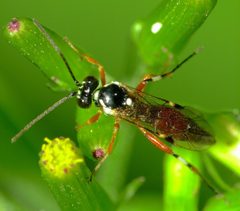
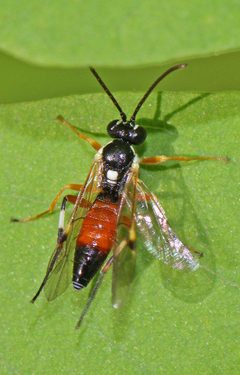
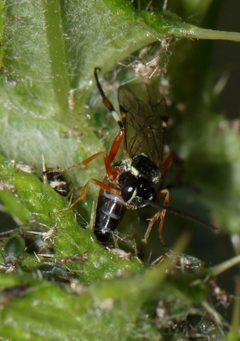
Diplazon laetatorius is a common ichneumonid and specialized of hoverflies (Syrphidae). It is distinguished by a broadly red-striped and hind tibia with a distinctive black-white-black-red banding pattern. The is thelytokous (parthenogenetic), with males occurring only rarely in India and North America; most reproduce without males. It is widespread across Britain and much of the world, often observed in gardens.
Pronunciation
How to pronounce Diplazon laetatorius: /dɪˈpleɪzɒn liːtəˈtɔːriəs/
These audio files are automatically generated. While they are not always 100% accurate, they are a good starting point.
Identification
Distinguished from similar ichneumonids by the combination of a broadly red-striped metasoma and hind tibia banded black, white, black, and red. The color pattern is considered unique among related . Males are extremely rare; the presence of males may indicate geographic origin (India or North America).
Images
Habitat
Ubiquitous across diverse in Britain, including gardens. Occurs in varied environments where hoverfly are present.
Distribution
Throughout much of the world including Britain, India, and North America. Records also exist from the Azores (Faial, Flores, Pico, São Jorge, São Miguel).
Diet
feed on floral nectar, with documented preference for flowers in the umbellifer (Apiaceae).
Host Associations
- Episyrphus balteatus - primary
- aphid-feeding hoverflies (Syrphidae) - general group
Life Cycle
Females oviposit into hoverfly or early instar larvae. The larva develops internally, consuming the from within. Diplazontine larvae induce hosts to pupariate early. The emerges from the .
Behavior
Possesses unusual tridentate adapted for from Diptera by cutting successive semicircular strips. Diplazontine larvae are immune to by immune systems; the mechanism remains unknown.
Ecological Role
of -feeding hoverflies, contributing to regulation of hoverfly that prey on aphids.