
Cryptanura
Brullé, 1846
Species Guides
2Cryptanura is a of ichneumonid wasps in the Cryptinae, containing at least 38 in North America. These are of other insects, with documented including longhorn beetles (Cerambycidae). The genus includes species that serve as models for by phytophagous . At least 30 species occur in Mexico, with the genus distributed from North America through Central America to South America.
Pronunciation
How to pronounce Cryptanura: //ˌkrɪp.təˈnʊr.ə//
These audio files are automatically generated. While they are not always 100% accurate, they are a good starting point.
Identification
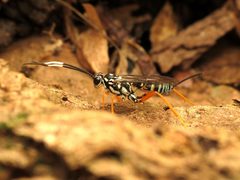
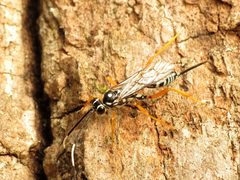
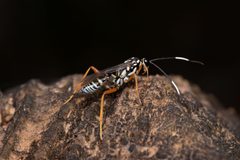
Distinguished from similar Cryptinae by combination of: dark body with white spots on and ; entirely red ; long with black and white banding; legs with yellow and red colouration. For North American , consult the key in Zoosystematica Rossica (2006). Distinguished from its mimic Holymenia clavigera by wing structure (membranous wings with venation vs. ), antennae spanning movements during foraging, and presence of ovipositor .
Images
Appearance
Medium-sized ichneumonid wasps with long (approximately 87% of body length in observed specimens). Dark body with white spots on and ; entirely red. Antennae with black and white colouration. Legs with yellow and red colouration. Prominent ovipositor (3.2 mm in measured specimen). Hyaline wings with salient nervures.
Habitat
Seasonal secondary forest (semideciduous seasonal forest); native forest fragments. Forages near leaf litter on forest floor. Associated with fallen trunks of woody plants including Lacmella panamensis.
Distribution
North America (38+ ), Mexico (30 species), Panama, and Brazil (Minas Gerais State).
Seasonality
Peak foraging activity observed from 09:00 to 12:00 in Brazilian .
Host Associations
- Taeniotes scalatus - New record; Cerambycidae: Lamiinae larvae in fallen trunk of Lacmella panamensis
Behavior
Solitary forager on forest floor, searching in and above leaf litter. Remains resting on substrate (fresh or dry leaves and branches) for approximately 7.00 ± 2.30 seconds on average. Performs spanning movements of during foraging. More abundant than its mimic Holymenia clavigera in observed (18 vs. 4 specimens).
Ecological Role
of wood-boring larvae; contributes to biocontrol of timber and agricultural pests. Serves as model for by phytophagous , providing protective signaling to mimics.
Human Relevance
Potential biocontrol agent for suppression of cerambycid pests damaging timber crops and agriculture. Subject of mimicry research due to role as model for coreid mimicry.
Similar Taxa
- Holymenia clavigeraPhytophagous coreid that exhibits of Cryptanura sp.; shares similar colouration (dark with white spots, red ), size, and foraging behaviour including spanning movements
More Details
Taxonomic diversity
The is taxonomically diverse with 10 new described from Mexico in 2006. Two synonymies established: Cryptanura ectypa (Cresson, 1873) = C. vallis Porter, 1977; and C. nitidiuscula Cameron, 1886 = C. bicarinata Cushman, 1945.
Mimicry system
Strong morphological and behavioural convergence with Holymenia clavigera represents one of few documented cases of involving phytophagous and ichneumonid wasps. Similarities include colour pattern, size, foraging behaviour, and sympatric distribution.
Sources and further reading
- BugGuide
- GBIF taxonomy match
- iNaturalist taxon
- NCBI Taxonomy
- Catalogue of Life
- Cryptanura sp. (Hymenoptera: Ichneumonidae: Cryptinae), parasitoide de Taeniotes scalatus Gmelin 1790 (Coleoptera: Cerambycidae: Lamiinae) en Panamá
- Review of Mexican species of the genus Cryptanura Brullé with a key to species from North America (Hymenoptera: Ichneumonidae: Cryptini)
- A brief observation of morphological and behavioral similarities between the Ichneumonidae wasp Cryptanura sp. and its presumed mimic, Holymenia clavigera (Heteroptera: Coreidae), in Brazil