
Lymeonina
Genus Guides
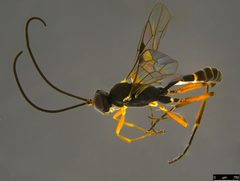
2Lymeonina is a subtribe of within the Ichneumonidae, Campopleginae. Members of this subtribe are characterized by their role as parasitoids of other insects, though specific associations remain incompletely documented. The subtribe was established based on morphological features of the ovipositor and wing venation. Lymeonina includes the Lymeon, which contains numerous described distributed across multiple continents.
Pronunciation
How to pronounce Lymeonina: /ˌlaɪ.miːˈoʊ.niː.nə/
These audio files are automatically generated. While they are not always 100% accurate, they are a good starting point.
Identification
Lymeonina can be distinguished from other subtribes of Campoplegini by features of the fore wing venation, particularly the arrangement of areoles in the discoidella and the structure of the ovipositor . The ovipositor is typically long and slender, often with a notch on the lower valve. Members lack the distinctive pronotal carinae found in some related campoplegine groups. Antennal segment counts and the degree of facial polishing provide additional diagnostic characters, though these require microscopic examination.
Images
Distribution
Lymeonina has a broad geographic distribution spanning the Holarctic, Neotropical, Oriental, and Australasian regions. Records extend from North America and Europe through East Asia to Australia and New Zealand. The subtribe appears most diverse in temperate and subtropical zones, with reduced representation in tropical lowlands.
Ecological Role
As members of Campopleginae, Lymeonina function as koinobiont endoparasitoids, developing within living that continue to feed and grow during . This lifestyle contributes to of host insects, though specific host ranges for most species remain undocumented.
Similar Taxa
- CampopleginaAnother subtribe of Campoplegini, distinguished from Lymeonina by differences in fore wing areolation, particularly the presence of a complete areolet and the structure of the nervellus.
- DusonaA within Lymeonina (per some classifications) or a related group, often confused due to similar body form; distinguished by details of the and ovipositor tip structure.
More Details
Taxonomic history
The subtribe Lymeonina was proposed by Townes in 1945 and has undergone various circumscription changes. The inclusion and ranking of constituent , particularly Lymeon and Dusona, has varied among authors, with some treatments recognizing Dusona as a separate subtribe or placing both genera directly in Campoplegini without subtribal division.
Species diversity
The Lymeon, the primary genus in Lymeonina, contains over 100 described , though many remain poorly characterized and data are sparse for most.