
Ischnus inquisitorius
(Müller, 1776)
Species Guides
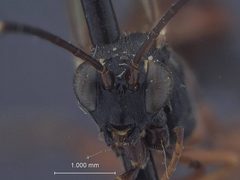
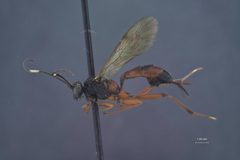
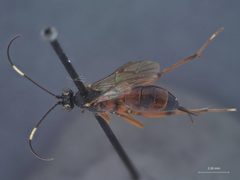
1Ischnus inquisitorius is a small ichneumonid of the Cryptinae, approximately 7 mm in length, with distinctive sexually dimorphic coloration. The was formerly known as I. migrator due to a misidentification of Fabricius's types, but the valid name was re-established by Horstmann in 2001. It is a widespread of tortricid pupae across the Holarctic region.
Pronunciation
How to pronounce Ischnus inquisitorius: /ˈisk.nəs ˌɪn.kwɪ.zɪˈtɔːr.i.əs/
These audio files are automatically generated. While they are not always 100% accurate, they are a good starting point.
Identification
Distinguished from similar ichneumonids by the combination of small size (~7 mm), black mesosoma with red metasoma in females, and characteristic white markings on scutellum and orbits. Males display additional white striping on the metasoma and mesosoma. Formerly confused with I. migrator; correct identification requires reference to Horstmann (2001) for nomenclatural clarification.
Images
Habitat
Widespread woodland ; can be readily collected by beating foliage. Associated with supporting tortricid .
Distribution
Trans-Holarctic distribution: widespread across the Palaearctic and Nearctic regions, extending south to Mexico. Recorded from Belgium (including Brussels-Capital, Flemish, and Walloon regions), Canada (Calgary), and the United Kingdom (Oxfordshire, England).
Seasonality
females hibernate; one per year.
Host Associations
- Tortricidae - pupal Attacks leaf-rolling tortricid moths; includes some economically important forestry and agricultural pests in North America
Life Cycle
(one per year). laid externally on pupa. Larva begins feeding externally, then burrows into the pupa to complete development.
Behavior
females hibernate. Adults can be collected by beating vegetation.
Ecological Role
Minor constituent of the guild attacking tortricid moths. Contributes to of some economically important forestry and agricultural pests in North America.
Human Relevance
Potential agent for tortricid pests in forestry and agriculture. Subject of sequencing as part of the Darwin Tree of Life project (232.18 Mb haploid genome from Wytham Woods specimen).
Similar Taxa
- Ischnus migratorFormerly confused due to misinterpretation of Fabricius's types; I. inquisitorius is the valid name re-established by Horstmann (2001)
Misconceptions
The name I. migrator was widely used due to a misinterpretation of ; this has been corrected and I. inquisitorius is now the accepted valid name.
More Details
Genomic Resources
Chromosomally complete haploid sequence of 232.18 Mb generated from specimen collected in Wytham Woods, Oxfordshire, UK as part of the Darwin Tree of Life project (Wellcome Open Research, 2025).
Nomenclatural History
Valid name re-established by Horstmann (2001) following clarification of Müller (1776) and Fabricius type material.