
Mirax
Haliday, 1833
miracine wasps
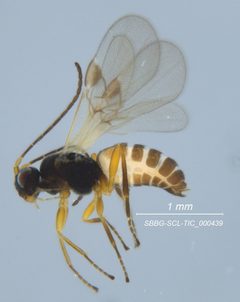
Mirax is a of tiny in the Miracinae (Braconidae). are typically 1–2 mm in length and are koinobiont endoparasitoids of leaf-mining caterpillars. The genus has been documented in Australia, Puerto Rico, and other regions, with several species described through citizen science initiatives. Some species, such as Mirax insularis, have been studied for their potential as agents of agricultural pests.
Pronunciation
How to pronounce Mirax: /ˈmɪr.æks/
These audio files are automatically generated. While they are not always 100% accurate, they are a good starting point.
Identification
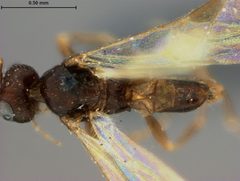
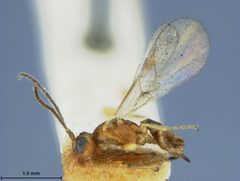
Members of Mirax are distinguished from other braconid by characteristics of the Miracinae, including reduced wing venation and small body size (typically 1–2 mm). Definitive identification to level requires examination of morphological features such as , ovipositor, and wing structure, often necessitating taxonomic expertise.
Images
Habitat
Mirax have been collected in diverse environments including rural and agricultural landscapes. Mirax insularis occurs in coffee agroecosystems. Australian species have been collected using in regional and remote areas, suggesting presence in varied terrestrial where leaf-mining caterpillar occur.
Distribution
Documented from Australia (Queensland, South Australia, Western Australia), Puerto Rico, and with records from Denmark, Sweden, and Vermont (USA). The appears to have broad geographic distribution, though precise ranges for most remain poorly documented.
Host Associations
- Leucoptera coffeella - koinobiont endoparasitoid (Lepidoptera: Lyonetiidae); Mirax insularis parasitizes larval stages, preferentially second instar
- leaf-mining caterpillars - koinobiont endoparasitoidgeneral association for ; larvae develop inside host caterpillars
Life Cycle
Koinobiont endoparasitoid development: are laid inside leaf-mining caterpillar , and larvae consume the host from within. For Mirax insularis, parasitization rates are higher on second instar larvae (7%) than first instar (5%), with greater progeny production at optimal densities.
Behavior
females exhibit instar preference, with Mirax insularis showing stronger attraction to and higher oviposition on second instar host larvae. -dependent reproductive response has been observed, with 60–80 per experimental unit producing optimal progeny (365–480 individuals) on second instar hosts.
Ecological Role
agent of leaf-mining caterpillars. Mirax insularis has been investigated for control of (), a significant pest of coffee plantations. The contributes to natural regulation of herbivorous insect in agricultural and natural .
Human Relevance
Potential biocontrol agent for agricultural pests. Mirax insularis has been studied for management of in Puerto Rico. Australian have been described through citizen science projects involving school students, contributing to public engagement with entomology and .
Similar Taxa
- Centistidea striataalso a miracine used for biocontrol of in Brazil; distinguished by geographic distribution and associations
- other Braconidae generaMiracinae members share reduced wing venation and small size; definitive separation from other requires examination of wing structure and other morphological characters
Sources and further reading
- BugGuide
- Wikipedia
- GBIF taxonomy match
- iNaturalist taxon
- NCBI Taxonomy
- Catalogue of Life
- Inspiring a new generation of taxonomists | Blog
- Reproductive capacity of Mirax insularis - Muesebeck (Hym: Braconidae) in larvae of the coffee leaf miner, Leucoptera coffeella- Guérin-Méneville and Perrottet 1842 (Lep: Lyonetiidae).
- HOST INSTAR PREFERENCE OF MIRAX INSULARIS (MUESEBECK) (HYMENOPTERA: BRACONIDAE), A KOINOBIONT PARASITOID OF LEUCOPTERA COFFEELLA GUERIN-MÉNÉVILLE (LEPIDOPTERA: LYONETIIDAE)