
Miracinae
Dana, 1853-1855
miracine wasps
Genus Guides
1- Mirax(miracine wasps)
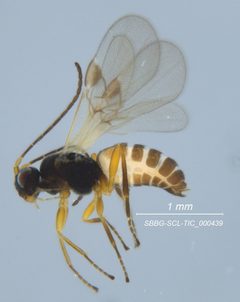
Miracinae is a poorly known of in the Braconidae. These minute wasps, typically measuring 1–2 mm in length, are rarely collected using traditional methods but appear to be diverse in Australia and other regions. Recent taxonomic work has described multiple new from Australia, Brazil, India, Colombia, and the Dominican Republic, including three species named through citizen science collaboration with Australian school students.
Pronunciation
How to pronounce Miracinae: //mɪˈræ.sɪˌniː//
These audio files are automatically generated. While they are not always 100% accurate, they are a good starting point.
Identification
Miracinae can be distinguished from other Braconidae by their extremely small size (1–2 mm) and, in some , distinctive metasomal tergite structure. The two extant genera Centistidea and Mirax can be separated based on morphological characters detailed in recent taxonomic keys. Identification to level requires careful examination of wing venation, structure, and metasomal sculpturing patterns. of the COI gene has been used to support species delimitation in Australian species.
Images
Appearance
Extremely small , typically 1–2 mm in body length. The includes with distinctive metasomal ; some recently described Neotropical genera (Paramomirax and Fusimirax) exhibit unusual patterns of desclerotization of the metasomal tergites that differ strikingly from previously known Miracinae. Specific morphological characters vary considerably among the two extant genera Centistidea and Mirax.
Habitat
associations are poorly documented. Known records include paramo vegetation at high elevation in Colombia (Paramomirax peckorum), lower elevation forests in the Dominican Republic (Fusimirax ), and various localities in Australia, Brazil, India, and Saudi Arabia. The Australian species were collected using in regional school settings, suggesting occurrence in general terrestrial habitats with vegetation supporting their caterpillars.
Distribution
Documented from Australia (Queensland, South Australia, Western Australia), Brazil, Colombia, Dominican Republic, India (first record for the ), Saudi Arabia (first record for Centistidea), and South Korea. The subfamily appears to have a wide but patchily documented distribution across the Neotropical, Oriental, and Australasian regions.
Host Associations
- leaf-mining caterpillars - primary group; lay inside caterpillars that feed inside leaves
- bark-mining moth larvae - association inferred from related Miracinae with known hosts
- Acrocercops phaeospora - reared from this leaf-mining in India (Centistidea acrocercopsi)
- Cosmopteryx phaeogastra - reared from this leaf-mining in India (Centistidea cosmopteryxi)
- Leucoptera coffeella - coffee leaf-miner; attacked by Mirax insularis in Puerto Rico
- Perileucoptera coffeella - coffee leaf-miner; attacked by Centistidea striata in Brazil
Life Cycle
Koinobiont development. Females lay inside leaf-mining caterpillars. larvae hatch and consume the from the inside, eventually killing it. Specific details of larval instars, sites, and development times are not documented for most .
Behavior
are rarely observed in the field. They are difficult to collect using traditional insect sampling methods but have been successfully sampled using . location presumably involves detection of leaf mines or host plant cues, though this has not been studied directly.
Ecological Role
agents of leaf-mining and bark-mining larvae. Their -specificity makes them potentially valuable for targeted pest management. Documented use in coffee pest management includes Mirax insularis controlling coffee leaf-miners in Puerto Rico and Centistidea striata in Brazil.
Human Relevance
Used in of agricultural pests, particularly coffee leaf-miners. Recent citizen science projects (Insect Investigators in Australia) have engaged school students in the taxonomic process, resulting in three new descriptions (Mirax supremus, M. ceduna, M. kaatijan) and fostering public appreciation for insect diversity and .
Similar Taxa
- other Braconidae subfamiliesMiracinae can be distinguished by their minute size (1–2 mm) and, in some , distinctive metasomal tergite desclerotization patterns; most other braconid contain larger or lack these specific metasomal modifications
- Microgasterinaeanother of small Braconidae ; Miracinae differs in associations (leaf-miners vs. caterpillars for Microgasterinae) and specific wing venation and metasomal characters
More Details
Taxonomic status
Miracinae was established by Dana in 1853–1855. The contains two extant : Centistidea (speciose and widely distributed) and Mirax. Recent molecular phylogenetic work using COI has supported delimitation in Australian species.
Collection challenges
These are very difficult to collect using traditional methods, contributing to their poor representation in museum collections. have proven effective for sampling, as demonstrated by the Australian Insect Investigators project which collected over 60,000 specimens.
Sources and further reading
- BugGuide
- iNaturalist taxon
- NCBI Taxonomy
- Catalogue of Life
- Inspiring a new generation of taxonomists | Blog
- Two new Neotropical genera of Miracinae (Hymenoptera, Braconidae) with unusual metasomal morphology
- The species of Centistidea Rohwer, 1914 (Hymenoptera: Braconidae: Miracinae) from Brazil
- First Indian record of Centistidea Rohwer (Hymenoptera: Braconidae, Miracinae) with description of eight new species
- Three new species of the genus Centistidea Rohwer, 1914 (Hymenoptera, Braconidae, Miracinae) from India and Saudi Arabia
- Braconidae (Hymenoptera) in the collection of the Institute of Zoology, NAS of Azerbaijan Republic Part V. Subfamilies Chardichilinae, Microgasterinae and Miracinae
- Three new species of Australian miracine parasitoid wasps collected by regional schools as part of the Insect Investigators citizen science project (Hymenoptera, Braconidae, Miracinae)
- Supplementary material 2 from: Slater-Baker M-R, Guzik M, Rodriguez J, Howe A, Woodward A, Ducker N, Fagan-Jeffries E (2025) Three new species of Australian miracine parasitoid wasps collected by regional schools as part of the Insect Investigators citizen science project (Hymenoptera, Braconidae, Miracinae). Journal of Hymenoptera Research 98: 19-45. https://doi.org/10.3897/jhr.98.137806
- Supplementary material 4 from: Slater-Baker M-R, Guzik M, Rodriguez J, Howe A, Woodward A, Ducker N, Fagan-Jeffries E (2025) Three new species of Australian miracine parasitoid wasps collected by regional schools as part of the Insect Investigators citizen science project (Hymenoptera, Braconidae, Miracinae). Journal of Hymenoptera Research 98: 19-45. https://doi.org/10.3897/jhr.98.137806
- Supplementary material 3 from: Slater-Baker M-R, Guzik M, Rodriguez J, Howe A, Woodward A, Ducker N, Fagan-Jeffries E (2025) Three new species of Australian miracine parasitoid wasps collected by regional schools as part of the Insect Investigators citizen science project (Hymenoptera, Braconidae, Miracinae). Journal of Hymenoptera Research 98: 19-45. https://doi.org/10.3897/jhr.98.137806
- Supplementary material 6 from: Slater-Baker M-R, Guzik M, Rodriguez J, Howe A, Woodward A, Ducker N, Fagan-Jeffries E (2025) Three new species of Australian miracine parasitoid wasps collected by regional schools as part of the Insect Investigators citizen science project (Hymenoptera, Braconidae, Miracinae). Journal of Hymenoptera Research 98: 19-45. https://doi.org/10.3897/jhr.98.137806
- Supplementary material 5 from: Slater-Baker M-R, Guzik M, Rodriguez J, Howe A, Woodward A, Ducker N, Fagan-Jeffries E (2025) Three new species of Australian miracine parasitoid wasps collected by regional schools as part of the Insect Investigators citizen science project (Hymenoptera, Braconidae, Miracinae). Journal of Hymenoptera Research 98: 19-45. https://doi.org/10.3897/jhr.98.137806
- Figure 1 from: Slater-Baker M-R, Guzik M, Rodriguez J, Howe A, Woodward A, Ducker N, Fagan-Jeffries E (2025) Three new species of Australian miracine parasitoid wasps collected by regional schools as part of the Insect Investigators citizen science project (Hymenoptera, Braconidae, Miracinae). Journal of Hymenoptera Research 98: 19-45. https://doi.org/10.3897/jhr.98.137806
- Supplementary material 1 from: Slater-Baker M-R, Guzik M, Rodriguez J, Howe A, Woodward A, Ducker N, Fagan-Jeffries E (2025) Three new species of Australian miracine parasitoid wasps collected by regional schools as part of the Insect Investigators citizen science project (Hymenoptera, Braconidae, Miracinae). Journal of Hymenoptera Research 98: 19-45. https://doi.org/10.3897/jhr.98.137806
- Figure 5 from: Slater-Baker M-R, Guzik M, Rodriguez J, Howe A, Woodward A, Ducker N, Fagan-Jeffries E (2025) Three new species of Australian miracine parasitoid wasps collected by regional schools as part of the Insect Investigators citizen science project (Hymenoptera, Braconidae, Miracinae). Journal of Hymenoptera Research 98: 19-45. https://doi.org/10.3897/jhr.98.137806
- Figure 6 from: Slater-Baker M-R, Guzik M, Rodriguez J, Howe A, Woodward A, Ducker N, Fagan-Jeffries E (2025) Three new species of Australian miracine parasitoid wasps collected by regional schools as part of the Insect Investigators citizen science project (Hymenoptera, Braconidae, Miracinae). Journal of Hymenoptera Research 98: 19-45. https://doi.org/10.3897/jhr.98.137806