
Halictus tripartitus
Cockerell, 1895
Tripartite Sweat Bee
Halictus tripartitus is a medium-sized sweat bee in the Halictidae, native to North America. The exhibits partial eusociality, with nests connected underground and some retaining reproductive capability. It is a documented of Silene spaldingii and other flowering plants. The species has been observed foraging on sunflowers and coneflowers alongside other native bees.
Pronunciation
How to pronounce Halictus tripartitus: /həˈlɪktəs traɪˈpɑːrtɪtəs/
These audio files are automatically generated. While they are not always 100% accurate, they are a good starting point.
Identification
Distinguished from metallic green sweat bees (Agapostemon spp.) by its brown or blackish coloration with white abdominal bands. Differs from the closely related Halictus ligatus and Halictus poeyi by subtle morphological features; precise identification may require examination of wing venation or microscopic characters. Separated from Lasioglossum by larger size and banded rather than uniformly dark or metallic .
Images
Appearance
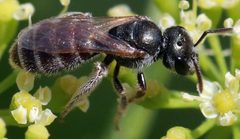
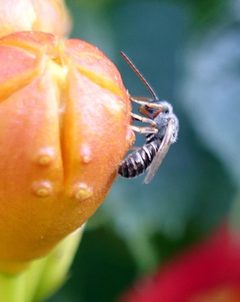
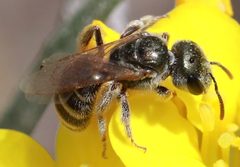
Medium-sized sweat bee with brown or blackish coloration and white bands across the . As a member of the Halictus, it lacks the metallic green or blue coloration seen in related genera such as Agapostemon. The possesses the short tongue typical of halictid bees, adapted for lapping sweat and accessing nectar.
Habitat
Nests in soil, with underground connected burrows. Occupies open areas with suitable ground nesting substrates. Has been observed in meadows, gardens, and other environments with exposed soil and flowering vegetation.
Distribution
Native to North America. Distribution records indicate presence in the United States and potentially Middle America. Documented in California and other western states.
Seasonality
Active during spring and summer months. Colonies are founded in spring by overwintered females.
Diet
that collects nectar and pollen from diverse flowering plants. Documented visiting Echinacea purpurea (purple coneflower), Helianthus sp. (sunflower), and Silene spaldingii. Has been observed lapping human sweat for salts and minerals.
Host Associations
- Silene spaldingii - Documented of this plant
Life Cycle
Partially eusocial . Nests are founded in spring by solitary females. Nests become connected underground as colonies develop. are produced and assist with foraging and care. Some workers retain reproductive capability and may produce their own offspring under favorable conditions.
Behavior
Exhibits partial eusociality with flexible social structure. forage for nectar and pollen, storing pollen in corbiculae () on hind legs. Some individuals engage in sweat-lapping on humans. Nests are connected underground, allowing movement between burrows.
Ecological Role
of native and ornamental flowering plants. Contributes to pollination services in natural and urban environments. As a native , provides pollination effectiveness that may exceed that of non-native honey bees on a per-visit basis.
Human Relevance
Beneficial in gardens and agricultural settings. May land on humans to lap sweat, which is harmless though can startle observers. Females can sting if crushed or handled roughly, though the sting is generally mild. Contributes to the diversity of native bees that support function and pollination .
Similar Taxa
- Halictus ligatusClosely related with similar size, coloration, and banded ; may require microscopic examination to distinguish
- Halictus poeyiSimilar appearance and ; historically confused with H. tripartitus in some regions
- Agapostemon spp.Also called sweat bees but distinguished by brilliant metallic green or blue coloration rather than brown/black with white bands
- Lasioglossum spp.Smaller sweat bees, often brassy or dark rather than distinctly banded, with different nesting
More Details
Pollination effectiveness
Halictus tripartitus was featured in research demonstrating that native bees can be more effective than honey bees on a per-visit basis. The was identified in a photograph on sunflower alongside Halictus ligatus, Svastra obliqua, and Apis mellifera as part of a study on single-visit pollination effectiveness.
Social flexibility
The partial eusociality of H. tripartitus, with connected nests and reproductive , represents an intermediate social organization between solitary and fully eusocial . This flexibility may allow colonies to respond to environmental conditions.
Sources and further reading
- BugGuide
- Wikipedia
- GBIF taxonomy match
- iNaturalist taxon
- Catalogue of Life
- Are Honeybees the Most Effective Pollinators? | Bug Squad
- 'Bee' One in a Million | Bug Squad
- Going Native: Do You Know the Native Bees of California? | Bug Squad
- Sweet times for sweat bees: Sweat bees, Halictus ligatus and Agapostemon virescens — Bug of the Week
- Ground nesting bees, beware the bee fly: Bombyliidae — Bug of the Week
- Bug Eric: Don't Sweat 'em