
Halictus poeyi
Lepeletier, 1841
Poey's Furrow Bee
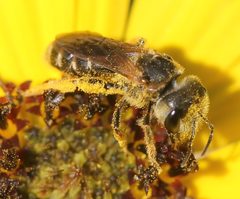
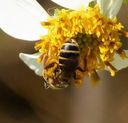
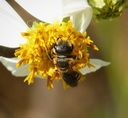
Halictus poeyi is a primitively eusocial sweat bee in the Halictidae, commonly known as Poey's furrow . The exhibits notable geographic variation in colony cycle : northern and central Florida are with annually brooded colonies, while southern Florida and Florida Keys populations are multivoltine with continuously brooded colonies. This plasticity appears driven by environmental conditions rather than genetic differentiation. Males form nighttime roosting clusters on vegetation, showing area fidelity within approximately 1.5 meters. The species is morphologically indistinguishable from Halictus ligatus, requiring genetic or detailed behavioral analysis for separation.
Pronunciation
How to pronounce Halictus poeyi: /hæˈlɪktəs ˈpoʊji/
These audio files are automatically generated. While they are not always 100% accurate, they are a good starting point.
Identification
Morphologically indistinguishable from Halictus ligatus; separation requires examination of male genitalia or genetic analysis. General Halictus features include medium body size, brown to blackish coloration with pale bands across the . Females possess pollen-collecting scopae on hind legs.
Images
Habitat
Found in areas supporting Bidens pilosa and Emilia sonchifolia vegetation for male roosting; nests in soil. Northern and central Florida occupy regions with seasonal conditions favoring cycles; southern Florida and Florida Keys populations occur in environments supporting continuous .
Distribution
Southeastern United States (Florida: northern, central, and southern regions including Florida Keys); Jamaica, Antilles; Caribbean region.
Host Associations
- Bidens pilosa - Male roosting siteUsed for nighttime sleeping , not confirmed as pollen or nectar source
- Emilia sonchifolia - Male roosting siteUsed for nighttime sleeping , not confirmed as pollen or nectar source
Life Cycle
Primitively eusocial with two distinct colony cycle phenotypes: (1) with annually brooded colony cycle in northern and central Florida; (2) multivoltine with continuously brooded colony cycle in southern Florida and Florida Keys. Colonies founded in spring by overwintered females.
Behavior
Males form nighttime roosting clusters on floral plants, exhibiting area fidelity within approximately 1.5 meter rather than fidelity to specific plant individuals or . Roost site selection influenced by microhabitat structure, sunlight exposure, weather conditions, and plant structural characteristics. Primitively eusocial social structure with queens and daughters.
Similar Taxa
- Halictus ligatusMorphologically indistinguishable; considered . Both are medium-sized brownish sweat bees with pale abdominal banding. Separation requires examination of male genitalia or molecular methods.
More Details
Behavioral plasticity
The expression of versus multivoltine colony cycles in Halictus poeyi is influenced by environmental conditions (temperature, food availability) rather than genetic isolation between . Genetic differentiation (FST) between populations with different phenotypes was not significantly higher than between populations with similar phenotypes.
Male roosting observations
In Jamaica, male roosting clusters were observed over approximately 50 days with no emerging or nesting females found near the roosting sites, suggesting spatial separation between male roosting areas and female nesting activity.
Sources and further reading
- BugGuide
- Wikipedia
- GBIF taxonomy match
- iNaturalist taxon
- NCBI Taxonomy
- Catalogue of Life
- Are Honeybees the Most Effective Pollinators? | Bug Squad
- 'Bee' One in a Million | Bug Squad
- Going Native: Do You Know the Native Bees of California? | Bug Squad
- Sweet times for sweat bees: Sweat bees, Halictus ligatus and Agapostemon virescens — Bug of the Week
- Ground nesting bees, beware the bee fly: Bombyliidae — Bug of the Week
- Bug Eric: Don't Sweat 'em
- Genetic differentiation across a behavioural boundary in a primitively eusocial bee, Halictus poeyi Lepeletier (Hymenoptera, Halictidae)
- Observations of male Halictus poeyi Lepeletier (Hymenoptera: Halictidae) in their nighttime roosting clusters on floral plants in Jamaica, Antilles