
Augochloropsis viridula
(Smith, 1853)
Northeastern Sweat Bee
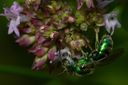
Augochloropsis viridula, commonly known as the northeastern sweat , is a metallic green bee in the Halictidae. The was first described by Frederick Smith in 1853, then treated as a of A. metallica, but was reinstated as a full species in 2022 based on taxonomic research. It is found in the midwestern United States and Canada. Like other halictids, it is a solitary bee that nests in soil.
Pronunciation
How to pronounce Augochloropsis viridula: /ˌɔːɡoʊklɔːˈrɒpsɪs vɪˈrɪdjʊlə/
These audio files are automatically generated. While they are not always 100% accurate, they are a good starting point.
Identification
Microscopic examination is required to distinguish Augochloropsis viridula from other Augochloropsis and from the similar-looking Augochlora and Augochlorella, which share the tribe Augochlorini and are virtually identical in appearance. The 2022 taxonomic revision separated A. viridula from A. metallica based on morphological and genetic data. It can be distinguished from cuckoo wasps (Chrysididae) by : sweat bees are commonly found on flowers, fly and alight more directly, and move less swiftly than the erratic, quick movements of cuckoo wasps. Female sweat bees carry pollen on their hind legs, which cuckoo wasps do not.
Images
Habitat
Found in areas where suitable nesting substrates occur, including soil for burrow excavation. Observed in agricultural landscapes including soybean fields.
Distribution
Midwestern United States and Canada. Not found as far west as Oklahoma, Kansas, or Nebraska. Distribution records include Vermont and other parts of North America.
Diet
feed on nectar and pollen. Females collect pollen using scopal hairs on the hind legs to provision nest for larvae.
Life Cycle
Solitary nesting with females excavating burrows in soil. Communal nesting or primitively social has been observed in related Augochlorini but specific documentation for A. viridula is limited. Larvae develop in provisioned nest .
Behavior
Females excavate soil burrows for nesting. visit flowers for nectar and pollen collection. Males perch on leaves and stems to watch for passing females. Both sexes may visit honeydew secreted by aphids and scale insects. Preening observed on sunlit leaves, generally taking longer than in cuckoo wasps.
Ecological Role
of flowering plants. Contributes to pollination services in natural and agricultural .
Human Relevance
Provides pollination services. May be mistaken for cuckoo wasps by observers. Subject of taxonomic research that clarified its status separate from A. metallica.
Similar Taxa
- Augochloropsis metallicaHistorically treated as ; separated in 2022 based on taxonomic study showing distinct status.
- Augochlora puraShares tribe Augochlorini and bright metallic coloration; distinguished by microscopic examination of morphological characters.
- Augochlorella speciesVirtually identical in appearance to untrained observers; requires microscopic examination to distinguish .
- Chrysididae (cuckoo wasps)Similar metallic green appearance; distinguished by , flower visitation, and presence of pollen-collecting structures on females.
Misconceptions
Previously treated as a (Augochloropsis metallica fulgida) rather than a full ; this was corrected in 2022.
More Details
Taxonomic History
Resurrected as a full in 2022 by University of Minnesota researchers who split A. metallica into five distinct : A. metallica, A. cuprea, A. fulgida, A. fulvofimbriata, and A. viridula.