
Augochloropsis metallica
(Fabricius, 1793)
Metallic epauletted-sweat bee
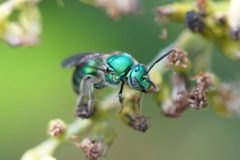
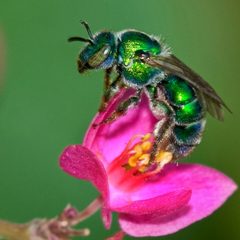
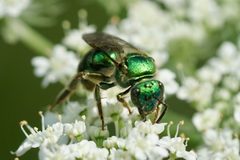
Augochloropsis metallica is a brilliant green metallic sweat bee in the Halictidae, native to Central and North America. First described by Fabricius in 1793, the underwent significant taxonomic revision when a former (A. fulgida) was elevated to species status, resulting in the division of the original A. metallica into five distinct species. The species is commonly found in the Midwest, Northeast, and Southern United States.
Pronunciation
How to pronounce Augochloropsis metallica: /ˌɔːɡəˌklɔːrˈɒpsɪs mɪˈtælɪkə/
These audio files are automatically generated. While they are not always 100% accurate, they are a good starting point.
Identification
Members of the tribe Augochlorini (including Augochloropsis, Augochlora, and Augochlorella) are virtually identical in appearance and require microscopic examination for definitive -level identification. Augochloropsis metallica can be distinguished from cuckoo wasps ( Chrysididae) by : sweat bees are commonly found on flowers, fly and alight more directly, move less swiftly, and take longer to preen. Cuckoo wasps flit about with quick, jerky movements and are seldom found on flowers. Female sweat bees with pollen loads on hind legs are definitively not cuckoo wasps.
Images
Habitat
Found in diverse environments across its range; commonly associated with flowering plants for foraging. Specific microhabitat preferences are not well documented in available sources.
Distribution
Native to Central America and parts of North America. In the United States, commonly found in the Midwest, Northeast, and Southern regions. GBIF records indicate presence in Canada, Colombia, Rica, Honduras, México, and Panamá.
Diet
feed on nectar from flowers. Females collect pollen using scopal hairs on hind legs to provision nest for offspring.
Life Cycle
Females excavate burrows in soil for nesting. Some within related exhibit communal nesting or primitively social , though specific nesting for A. metallica is not well documented.
Behavior
Commonly observed on flowers foraging for nectar and pollen. move with relatively direct and alighting patterns compared to the erratic movements of cuckoo wasps. Females may be seen returning to nest burrows with pollen loads. Males may perch on leaves and stems to watch for passing females.
Ecological Role
of flowering plants. Contributes to pollination services in natural and potentially agricultural environments.
Human Relevance
Provides pollination services. May be mistaken for cuckoo wasps due to similar metallic green appearance, leading to potential misidentification by observers.
Similar Taxa
- Augochlora puraAlso bright metallic green (though frequently brassy, coppery, or bronze), member of same tribe Augochlorini, requires microscopic examination to distinguish
- Augochlorella spp.Virtually identical metallic green appearance, same tribe, microscopic examination required for separation
- Agapostemon spp.Metallic green halictid bees; males have banded black and yellow unlike uniform green of Augochloropsis, females often have black abdomen with white hair bands
- Cuckoo wasps (family Chrysididae)Similar brilliant metallic green/blue coloration; distinguished by (seldom on flowers, quick jerky movements), lack of pollen-collecting structures, and different body proportions
Misconceptions
Frequently mistaken for cuckoo wasps due to shared metallic green coloration. The 'Metallic epauletted-sweat bee' and similar appearance to can lead to confusion, but sweat bees are true bees ( Halictidae) with pollen-collecting and different ecological roles.
More Details
Taxonomic History
Originally described by Fabricius in 1793. Formerly included two : metallica and fulgida. Recent taxonomic study elevated A. fulgida to full status, resulting in division of original A. metallica into five species: A. metallica, A. cuprea, A. fulgida, A. fulvofimbriata, and A. viridula.
Sampling Method Considerations
As a small-bodied sweat bee, this is likely to be captured in pan traps ( bowls), though mark-recapture studies suggest such methods may not accurately reflect relative abundance compared to aerial netting.
Sources and further reading
- BugGuide
- Wikipedia
- GBIF taxonomy match
- iNaturalist taxon
- NCBI Taxonomy
- Catalogue of Life
- Bug Eric: Metallica
- Coleoptera | Beetles In The Bush | Page 10
- How Mark-Recapture Methods Can Validate Wild Bee Sampling Protocols
- Denmark Museum Highlights UW Entomologist’s Naming of Shakira Wasp
- Bug Eric: Wasp Wednesday: Not Wasp VIII