
Augochlora aurifera
Cockerell, 1897
Auriferous Green Sweat Bee
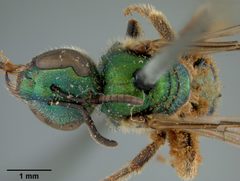
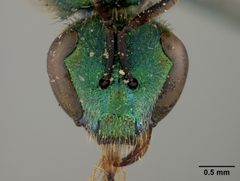
Augochlora aurifera is a metallic green sweat bee in the Halictidae, described by Cockerell in 1897. As a member of the tribe Augochlorini, it exhibits the characteristic bright metallic coloration common to this group. The is distributed across North America and Middle America. Like other Augochlora species, it is presumed to be solitary or primitively social, though specific behavioral details for A. aurifera remain poorly documented compared to better-studied such as Augochlora pura.
Pronunciation
How to pronounce Augochlora aurifera: /aʊˈɡɒkləɹə ˈɔːɹɪfərə/
These audio files are automatically generated. While they are not always 100% accurate, they are a good starting point.
Identification
Augochlora aurifera cannot be reliably distinguished from Augochlorella and Augochloropsis by external appearance alone; microscopic examination of morphological characters is required. Within Augochlora, separation from A. pura and other requires expert taxonomic analysis. The metallic coloration distinguishes the group from non-metallic halictids, but not from cuckoo wasps (Chrysididae) or other metallic bees such as Agapostemon.
Images
Appearance
Small with bright metallic green, blue-green, or golden-green . Members of the Augochlora are virtually identical in external appearance to related genera Augochlorella and Augochloropsis, requiring microscopic examination for definitive identification. The name "aurifera" (gold-bearing) suggests a particularly golden or brassy metallic sheen may be characteristic. Females possess scopae (pollen-collecting hairs) on the hind legs.
Habitat
Specific preferences for A. aurifera are undocumented. Related Augochlora nest in rotting wood or soil, suggesting forested or wooded environments with suitable nesting substrates. The species has been documented in mark-recapture studies conducted in game lands near Raleigh, North Carolina, indicating occurrence in mixed natural habitats.
Distribution
North America and Middle America. Documented from the eastern United States (North Carolina) and presumably ranging more broadly across the continent based on GBIF records.
Seasonality
Active during summer months. Documented in mark-recapture sampling during July-August 2020 in North Carolina.
Life Cycle
Presumed solitary or primitively social based on -level traits, but specific details for A. aurifera are undocumented. Related construct nest provisioned with pollen and nectar, with larvae developing within these cells before pupating and emerging as .
Behavior
Specific of A. aurifera are undocumented. Females of related forage on diverse flowering plants and may visit human perspiration for salts.
Ecological Role
Presumed based on -level characteristics and documented pollen collection in .
Human Relevance
Included in mark-recapture studies evaluating sampling methodologies, contributing to understanding of detectability and estimation techniques for wild bees.
Similar Taxa
- Augochlora puraCongeneric with overlapping range; external nearly identical, requiring microscopic examination for separation
- Augochlorella spp.Member of same tribe with virtually identical metallic green appearance; -level identification requires dissection and microscopic analysis
- Augochloropsis spp.Member of same tribe with virtually identical metallic green appearance; -level identification requires dissection and microscopic analysis
- Agapostemon spp.Metallic green halictid bees with similar appearance; males of Agapostemon have banded black and yellow , distinguishing them from most Augochlora
- Chrysididae (cuckoo wasps)Similar metallic coloration and size; distinguished by (seldom on flowers, quick jerky movements), lack of pollen-collecting structures, and different body proportions
More Details
Taxonomic challenges
The tribe Augochlorini presents significant identification challenges, with Augochlora, Augochlorella, and Augochloropsis being morphologically convergent. Augochlora aurifera specifically is less well-documented in the literature than the more common A. pura, and many ecological statements about 'Augochlora' in general sources may not apply to this .
Research significance
Augochlora aurifera was included as one of the 'green sweat bees' in a 2020 mark-recapture study validating sampling protocols, indicating its use as a representative for this common but taxonomically difficult group.
Sources and further reading
- BugGuide
- GBIF taxonomy match
- iNaturalist taxon
- Catalogue of Life
- Sweet and salty: Solitary sweat bee, Augochlora pura — Bug of the Week
- Bug Eric: Metallica
- Bugs in drawers: entomological outreach collections and their role in community engagement
- How Mark-Recapture Methods Can Validate Wild Bee Sampling Protocols