
Pseudomyrmex elongatus
(Mayr, 1870)
Mangrove Twig Ant
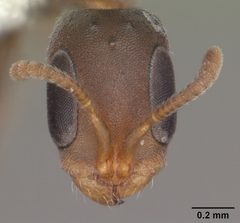
Pseudomyrmex elongatus is a small, slender in the Formicidae, distributed widely from Mexico to Argentina. It belongs to a characterized by exceptionally large relative to size and an elongate, -like body form. The species is commonly known as the Mangrove Twig Ant, suggesting association with coastal or riparian woody vegetation. are small (head width 0.56–0.68 mm) with a predominantly opaque head and elongated eyes.
Pronunciation
How to pronounce Pseudomyrmex elongatus: /ˌsjuːdoʊˈmɜrmɛks iːˌlɒŋˈɡeɪtəs/
These audio files are automatically generated. While they are not always 100% accurate, they are a good starting point.
Identification
Distinguished from similar small Pseudomyrmex by combination of small size (HW < 0.70 mm), opaque capsule, and elongated shape. Separated from P. flavidulus and P. gracilis by size (P. gracilis is larger, ~10 mm) and pilosity (P. gracilis is hairier). Differs from P. phyllophilus in petiole shape. Species-level identification in this requires examination of or expert verification due to numerous cryptic species and taxonomic complexity.
Images
Appearance
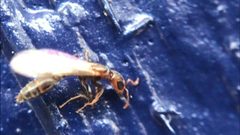
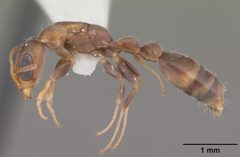
Small with slender, elongate, -like body form. width 0.56–0.68 mm. Head predominantly opaque (non-shiny). notably large and elongated relative to head size, a distinctive -level trait. Body coloration typically orangish to yellowish. Pilosity (hairiness) generally sparse compared to larger Pseudomyrmex . Petiole (waist segment) single-noded and slender.
Habitat
Associated with woody vegetation, particularly twigs and branches of trees and shrubs. 'Mangrove Twig ' indicates occurrence in coastal mangrove , though the also inhabits inland riparian and forest edge . Frequently found on palm trunks, bark, and slender branches where it forages and nests.
Distribution
Widespread across the Neotropics from Mexico to Argentina. Documented in numerous localities including Aguas Claras, Alejandría, Carmelita, Córcega, El Hatico, El Medio, Miralindo, Las Pilas, El Trapiche. Present throughout Brazil (Acre, Alagoas, Amazonas, Bahia, Ceará, Distrito Federal, Espírito Santo, Goiás, Maranhão, Minas Gerais, Mato Grosso, Pará, Paraíba, Pernambuco, Piauí, Rio de Janeiro, Rio Grande do Norte, Rondônia, Sergipe, São Paulo, Tocantins). Also recorded in the conterminous 48 United States.
Seasonality
Active year-round in subtropical and tropical regions. In seasonally wet environments of northeastern Argentina (Corrientes), observed active in early April (early autumn), indicating of dry season conditions when many other insects become . activity not strictly confined to moist seasons (September–January) unlike many co-occurring insects.
Life Cycle
Colony foundation by newly mated queens. Nesting in hollow twigs, bark crevices, or pre-existing cavities in woody vegetation. Complete with , larva, pupa, and stages. Specific details of development and colony size for this are not documented.
Behavior
Forages actively and continuously on woody substrates including tree trunks, branches, and twigs. Rapid, frenetic movement while foraging makes observation and photography difficult. exhibit tenacious crawling , frequently moving to the opposite side of branches when disturbed. Has been observed plucking small items from bark, suggesting foraging on surface-dwelling food sources.
Ecological Role
Arboreal forager in woody vegetation . Likely contributes to nutrient cycling and on small in and subcanopy . May serve as prey for larger arthropods, birds, and other . Specific functions for this are not documented.
Human Relevance
Minimal direct interaction with humans. Not known to be a significant pest or to possess a medically important sting. Presence in mangrove may indicate quality. Taxonomic complexity of the presents challenges for field identification and ecological study.
Similar Taxa
- Pseudomyrmex flavidulusSimilar small size and yellowish coloration; distinguished by subtle morphological differences requiring expert examination
- Pseudomyrmex gracilisLarger (~10 mm vs. <5 mm expected for P. elongatus), hairier body, and differently shaped petiole
- Pseudomyrmex phyllophilusSimilar and appearance; separated by petiole shape and pilosity characteristics
More Details
Taxonomic Complexity
The Pseudomyrmex contains approximately 209 described , with numerous cryptic . P. elongatus is part of a group of small, yellowish species that are difficult to distinguish without detailed morphological analysis. Phil Ward's ongoing taxonomic work suggests many named species may subsume multiple cryptic species.
Photographic Challenge
Members of this are notoriously difficult to photograph due to rapid, continuous movement, preference for narrow substrates, and habit of circling to the far side of branches when approached. Successful photography requires tracking the subject in the viewfinder and capturing numerous frames rather than waiting for pauses.
Sources and further reading
- BugGuide
- Wikipedia
- GBIF taxonomy match
- iNaturalist taxon
- NCBI Taxonomy
- Catalogue of Life
- The bodyguard: Pseudomyrmex ants protecting bullhorn acacias — Bug of the Week
- Rainforest Ants 3 – The Bodyguards, part 1: Pseudomyrmex ants protecting bullhorn acacias — Bug of the Week
- Pseudomyrmex in Corrientes, Argentina | Beetles In The Bush
- Bichos Argentinos #2 – Pseudomyrmex sp. | Beetles In The Bush