
Pseudomyrmex gracilis
(Fabricius, 1804)
graceful twig ant, Mexican twig ant, slender twig ant, elongated twig ant
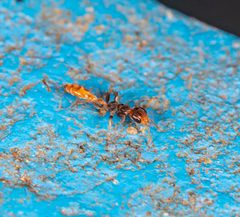
Pseudomyrmex gracilis is a large, slender characterized by -like appearance and rapid, frenetic movement. measure 8–10 mm and display distinctive bi-coloration: dark and contrasting with dull orange , mouthparts, , and legs. The species is native to Mexico and arid regions of the southern United States, with introduced established in Florida and Hawaii. It has been documented as an in the Florida Keys, where it impacts native .


Pronunciation
How to pronounce Pseudomyrmex gracilis: /ˌsjuːdoʊˈmɜrmɛks ˈɡræsɪlɪs/
These audio files are automatically generated. While they are not always 100% accurate, they are a good starting point.
Identification
are notably larger than most at 8–10 mm versus the typical 4–7 mm range for other Pseudomyrmex . Distinguished from similar species such as P. phyllophilus by a differently shaped petiole and greater overall pilosity (hairiness). The bi-colored pattern—dark and with orange and appendages—separates it from uniformly colored relatives. Large, prominent provide a distinctive 'charismatic' appearance compared to the small typical of most ants.
Images
Habitat
Arid and semi-arid environments including deserts and dry forests. Frequently observed on vegetation, particularly shrubs and trees with slender branches. In introduced range, inhabits subtropical dry forest .
Distribution
Native to Mexico and arid parts of the southern United States, particularly Texas. Introduced and established in Florida, USA, with now bridging the gap between native Texas range and non-native Florida range. Also present in Hawaii as an introduced population. Records from South America (Argentina, Brazil) likely represent related within the P. gracilis .
Diet
Predatory: forages for live insects. Also collects honeydew from sap-sucking insects (Hemiptera) as a source.
Life Cycle
Colonies are founded by newly mated queens. are sterile; colony depends on presence. In queenless colonies, workers establish through antennal boxing, with high-ranking individuals capable of laying until a new queen is acquired.
Behavior
Exhibits rapid, continuous movement while foraging along slender twigs and branches, making observation and photography difficult. When disturbed, deliver memorable bites and stings. In the absence of a , workers engage in established through antennal boxing.
Ecological Role
In native range, functions as a and honeydew collector. In introduced Florida range, classified as an with documented impacts on native wildlife, including federally endangered Schaus' swallowtail .
Human Relevance
Recognized as an in Florida where it threatens native . Featured in educational virtual reality game 'Butterfly World 1.0' to demonstrate invasive species impacts. Stings are memorable and cause localized pain and swelling.
Similar Taxa
- Pseudomyrmex phyllophilusSimilar size and coloration, but distinguished by petiole shape and lower pilosity; P. gracilis has more hairy appearance and differently shaped petiole.
- Pseudomyrmex flavidulusSmall, bright yellow-orange often confused with smaller P. gracilis individuals, but P. flavidulus is significantly smaller (approximately 4–7 mm) and lacks the dark of P. gracilis.
- Pseudomyrmex ferrugineaAcacia-associated mutualist with more uniform orange-brown coloration and obligate relationship with bullhorn acacias, versus the use of P. gracilis.
Sources and further reading
- BugGuide
- Wikipedia
- GBIF taxonomy match
- iNaturalist taxon
- NCBI Taxonomy
- Catalogue of Life
- Bichos Argentinos #2 – Pseudomyrmex sp. | Beetles In The Bush
- The bodyguard: Pseudomyrmex ants protecting bullhorn acacias — Bug of the Week
- Pseudomyrmex in Corrientes, Argentina | Beetles In The Bush
- Rainforest Ants 3 – The Bodyguards, part 1: Pseudomyrmex ants protecting bullhorn acacias — Bug of the Week
- Living room conservation: Gaming & virtual reality for insect and ecosystem conservation | Blog
- native fauna | Blog
- Populations of the Graceful Twig Ant, Pseudomyrmex gracilis, Now Bridge the Distribution Gap between Their Native Range in Texas and Non-Native Range in Florida, USA