
Pseudomyrmex apache
Creighton, 1953
Apache Twig Ant
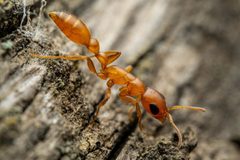
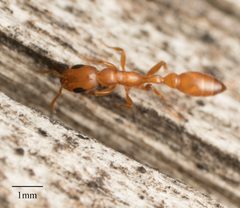
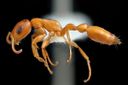
Pseudomyrmex apache is a of twig in the Pseudomyrmecinae. It is native to the southwestern United States and Mexico, with unconfirmed reports from Florida. The species is characterized by its golden yellow coloration and -like body form typical of the . Like other Pseudomyrmex species, it has notably large relative to body size.
Pronunciation
How to pronounce Pseudomyrmex apache: /ˌsjuːdoʊˈmɜrmɛks əˈpætʃeɪ/
These audio files are automatically generated. While they are not always 100% accurate, they are a good starting point.
Identification
The golden yellow coloration and 5–8 mm body length help distinguish P. apache from darker or differently colored Pseudomyrmex . Definitive identification to species level requires examination of morphological characters, ideally by a . The species may be confused with other yellow Pseudomyrmex species in the same geographic region.
Images
Appearance
Golden yellow in color. measure 5–8 mm in overall length. Body form is elongate and -like, typical of the Pseudomyrmex. The possesses characteristically large .
Habitat
Arid and semi-arid environments of the southwestern United States and adjacent Mexico. Specific microhabitat preferences within this range have not been documented in detail.
Distribution
Southwestern United States, Mexico, and possibly Florida. The Florida record requires verification.
Behavior
As with other Pseudomyrmex , are active foragers on vegetation. The species exhibits the rapid, continuous movement typical of the .
Similar Taxa
- Pseudomyrmex gracilisSimilar yellow coloration and body form, but P. gracilis is larger (10 mm+) and more pilose; petiole shape differs
- Pseudomyrmex flavidulusSimilar small size and yellow-orange coloration; occurs in South America rather than southwestern North America
More Details
Taxonomic note
The was described by William Morton Creighton in 1953. The Pseudomyrmex contains approximately 209 species, primarily distributed in the Neotropics.
Sources and further reading
- BugGuide
- Wikipedia
- GBIF taxonomy match
- iNaturalist taxon
- NCBI Taxonomy
- Catalogue of Life
- The bodyguard: Pseudomyrmex ants protecting bullhorn acacias — Bug of the Week
- Pseudomyrmex in Corrientes, Argentina | Beetles In The Bush
- Rainforest Ants 3 – The Bodyguards, part 1: Pseudomyrmex ants protecting bullhorn acacias — Bug of the Week
- Bichos Argentinos #2 – Pseudomyrmex sp. | Beetles In The Bush
- Bug Eric: Spider Sunday: Apache Jumping Spider
- Bug Eric: Bosque del Apache National Wildlife Refuge