
Anochetus mayri
Emery, 1884
Mayr's Lesser Trap-jaw Ant
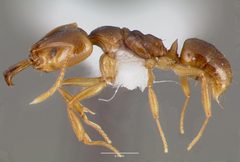
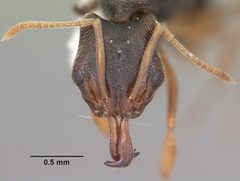
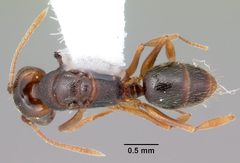
Anochetus mayri is a of trap-jaw in the Ponerinae, distributed across much of northern and central South America. Like other members of the Anochetus, it possesses enlarged capable of rapid closure to capture prey. The species was described by Carlo Emery in 1884 and remains relatively understudied compared to its Anochetus simoni. Records indicate presence in Brazil, Colombia, and other Neotropical regions, primarily in forested .
Pronunciation
How to pronounce Anochetus mayri: /ænəˈkiːtəs ˈmaɪri/
These audio files are automatically generated. While they are not always 100% accurate, they are a good starting point.
Identification
Distinguished from other Anochetus by the combination of mandibular and capsule proportions; specific diagnostic features require examination of type material and comparison with closely related species such as Anochetus simoni. The is characterized by elongate with a distinct basal angle and teeth, but species-level identification typically requires microscopic examination of morphological characters including clypeal structure, petiolar node shape, and body .
Images
Habitat
Forest in the Neotropical region; specific microhabitat preferences within forest are not well documented.
Distribution
Northern and central South America: Brazil (widespread across multiple states including Amazonas, Pará, Mato Grosso, and others), Colombia (departments of Bolívar and Magdalena), and potentially adjacent countries with suitable forest .
Behavior
As a trap-jaw , possesses the characteristic rapid closure mechanism used for prey capture and potentially for defensive propulsion (the 'escape jump' documented in other Anochetus ), though specific behavioral observations for A. mayri are lacking.
Ecological Role
in forest floor and understory ; likely contributes to and nutrient cycling through on small arthropods.
Similar Taxa
- Anochetus simoniClosely related with overlapping distribution; distinguished by subtle differences in mandibular and body proportions requiring expert examination.
- Anochetus boltoniAnother Neotropical ; separation relies on detailed morphological comparison of .
Sources and further reading
- BugGuide
- GBIF taxonomy match
- iNaturalist taxon
- NCBI Taxonomy
- Catalogue of Life
- Encyrtid Holdings | Entomology Research Museum
- An Introduction to the Wonderful World of Wasps: Meet the Heath Sand Wasp - Buglife Blog - Buglife
- Journal-to-wiki export and a joint citation mechanism for taxon descriptions | Blog