
Anochetus
Mayr, 1861
Anochetus Trap-jaw Ants
Species Guides
1- Anochetus mayri(Mayr's Lesser Trap-jaw Ant)
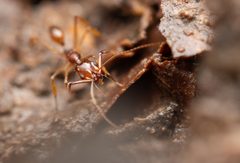
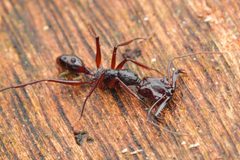
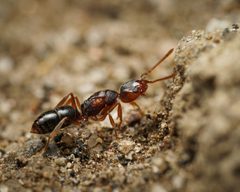
Anochetus is a of small, ants in the Ponerinae, distinguished by their specialized trap-jaw capable of rapid closure. The genus occurs throughout tropical and subtropical regions worldwide, with documented across the Neotropical, Afrotropical, Indomalayan, and Australasian biogeographic regions. Anochetus is one of only two genera (with Odontomachus) known to use trap-jaw mandibles for both prey capture and evasion. The genus contains approximately 100 described species, with fourteen recognized in Australia alone and ongoing taxonomic revisions clarifying regional diversity.
Pronunciation
How to pronounce Anochetus: /ˌænəˈkɛtəs/
These audio files are automatically generated. While they are not always 100% accurate, they are a good starting point.
Identification
Distinguished from other ponerine ants by the presence of trap-jaw with rapid closure capability. Differs from the related Odontomachus by generally smaller body size, more gracile build, and karyotypic differences including higher frequency of metacentric . Within Anochetus, identification requires examination of mandibular , capsule shape, petiolar node , and antennal sensillar patterns. The three studied species groups (longifossatus, graeffei, sedilloti) show diagnostic differences in size and antennal sensillar complexity.
Images
Habitat
Primarily occupies forested ranging from tropical rainforest to dry sclerophyll woodlands. In southern temperate regions, extends into drier shrub and bush-dominated sites. Specific collection records include tropical dry forest in Mexico (Chamela-Cuixmala Reserve), warm humid forests in Sumatra, and soil-nested and tree-base nesting sites in Central India. Elevation records span 20–160 meters in documented collections.
Distribution
Pantropical and subtropical distribution across all continents except Antarctica and Europe. Native to the Neotropical, Afrotropical, Indomalayan, and Australasian regions. In Europe, only Anochetus ghilianii is present (Province of Cádiz and Gibraltar), with uncertain native status; this is confirmed native to Morocco. First fossil record from Miocene amber of Sumatra extends known temporal and geographic range into the Indomalayan region. In Mexico, documented from Jalisco, Chiapas, Colima, Guerrero, Michoacán, Morelos, Oaxaca, Quintana Roo, San Luis Potosí, Sinaloa, Tamaulipas, Veracruz, and Yucatán. In Australia, twelve species are with two species shared with northern neighbours.
Diet
; predatory feeding habits. Trap-jaw used to capture prey through rapid closure mechanism.
Life Cycle
activity documented for at least some ; fossil female preserved in resin indicates winged reproductives participate in mating . Specific developmental stages and colony founding mechanisms not documented in available sources.
Behavior
Possesses trap-jaw used for both prey capture and evasion—the only besides Odontomachus known to employ this dual function. Mandibles can close with extreme rapidity to strike prey or, when directed against the substrate, to propel the backward away from threats. Nesting varies by : some nest in soil, others at tree bases. Foraging and colony social structure not well documented.
Ecological Role
Predatory role in terrestrial . Specific functions such as nutrient cycling, seed , or trophic cascade effects not documented in available sources.
Human Relevance
No documented direct economic or medical importance. Subject of scientific research regarding sensory , chromosomal evolution, and biomechanics of trap-jaw . Taxonomic revisions contribute to biodiversity documentation in tropical regions.
Similar Taxa
- OdontomachusShares trap-jaw and rapid closure mechanism; differs in generally larger body size, more robust build, karyotypic features (more telocentric ), and rDNA gene localization patterns. Phylogenetic analyses indicate Odontomachus likely evolved from within an Anochetus lineage.
More Details
Sensory Morphology
Antennal sensillar architecture shows interspecific variation correlated with size: small-eyed (A. myops) exhibit reduced sensillar diversity and unique with placodea; large-eyed species (A. obscurior) display highest sensillar diversity including novel trichoid forms and multiple coeloconic variants.
Karyotypic Evolution
Ancestral haploid number n=15 inferred for the ; most maintain this number with pericentric as primary rearrangement. Documented exceptions include reduction to n=14 in A. emarginatus and A. cf. madaraszi via centromeric fusion, and increase in A. horridus via centromeric fission.
Fossil Record
First Cenozoic record from outside Neotropics: Anochetus miosumatrensis from Miocene amber of Sumatra, attributed to extant group risii based on .
Sources and further reading
- BugGuide
- Wikipedia
- GBIF taxonomy match
- iNaturalist taxon
- NCBI Taxonomy
- Catalogue of Life
- Journal-to-wiki export and a joint citation mechanism for taxon descriptions | Blog
- Revision of the Australian species of the ant genus Anochetus (Hymenoptera: Formicidae)
- Primer registro del género Anochetus Mayr 1861 (Hymenoptera: Formicidae) para el estado de Jalisco, México
- Eco-Evolutionary Trends in Sensillar Architecture Across three distinct lineages of Anochetus, the trap jaw ants
- First report of the trap-jaw ant genus Anochetus Mayr, 1861 (Hymenoptera: Formicidae) from Central India with redescription of three species
- The first representative of the trap-jaw ant genus Anochetus Mayr, 1861 in Neogene amber from Sumatra(Hymenoptera: Formicidae)
- Phylogenetic Reconstruction of the Ancestral Chromosome Number of the Genera Anochetus Mayr, 1861 and Odontomachus Latreille, 1804 (Hymenoptera: Formicidae: Ponerinae)
- A Cytogenetic Approach to the Study of Neotropical Odontomachus and Anochetus Ants (Hymenoptera: Formicidae)