
Manica
Jurine, 1807
Species Guides
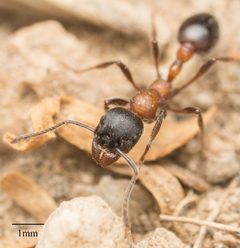
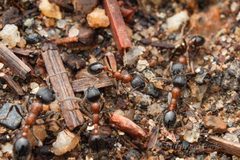
2Manica is a of ants in the Myrmicinae, Formicidae. The genus contains six described . These ants are distributed across the Holarctic region, with species found in North America and Eurasia. Manica ants are known to inhabit cool, montane environments and are among the few genera capable of surviving at high latitudes and elevations where conditions are challenging for most ant species.
Pronunciation
How to pronounce Manica: //ˈma.ni.ka//
These audio files are automatically generated. While they are not always 100% accurate, they are a good starting point.
Identification
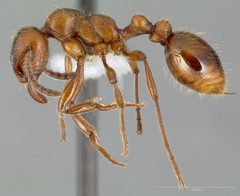
Manica ants can be distinguished from other Myrmicinae by their robust with distinct teeth, relatively large body size among cold-climate ants, and dense pilosity. They possess a characteristic two-segmented petiole and lack the well-developed propodeal spines seen in many related . are polymorphic, with size variation evident within colonies.
Images
Habitat
Cool temperate to subarctic montane environments. Found in forests, alpine meadows, and tundra-edge . Nests are typically constructed in soil, often under stones or in rotting wood. occur at elevations ranging from lowland boreal zones to high alpine areas above treeline.
Distribution
Holarctic distribution. occur in northern North America (including Alaska and Canada), across northern Eurasia, and in mountainous regions of Europe and Asia. The spans from approximately 35°N to 70°N latitude, with isolated extending into suitable high-elevation refugia at lower latitudes.
Seasonality
Active primarily during warmer months in high-latitude , with shortened activity periods compared to temperate . In alpine environments, activity is constrained by snow-free periods. Colonies may remain under snowpack for extended periods during winter.
Life Cycle
Colonies are typically monogynous (single ). Reproductive emerge in summer, with timed to coincide with favorable weather windows in short growing seasons. Colony foundation is likely claustral, with queens founding independently without foraging until the first eclose. Colony growth is slow relative to temperate , reflecting cold-climate constraints.
Behavior
Foraging occurs diurnally during suitable temperature conditions. are scavengers and . The exhibits cold-climate adaptations including of freezing conditions and ability to forage at lower temperatures than most ants. Nest has been observed, with workers moving to optimize temperature exposure.
Ecological Role
Important and scavengers in cold-climate where diversity is limited. Contribute to soil nutrient cycling through nest construction and refuse deposition. Serve as prey for predators and vertebrates in and alpine . Facilitate seed for some plant in montane .
Similar Taxa
- MyrmicaAlso in tribe Myrmicini with similar overall body plan, but Myrmica typically has more developed propodeal spines, different petiole proportions, and occupies broader temperate rather than specializing in cold-climate environments.
- FormicaShares Holarctic distribution and montane preference in some , but Formica belongs to Formicinae with a single-segmented petiole and often exhibits mound-building not seen in Manica.
More Details
Cold-climate specialization
Manica represents one of the most cold-adapted , with physiological and behavioral traits enabling survival in environments where most ant cannot persist. This includes freeze mechanisms and metabolic adaptations to short activity seasons.
Taxonomic stability
The has remained taxonomically stable since its establishment, with six recognized and limited synonymy compared to many other genera. This reflects both genuine species rarity and the remote that limit collection and revisionary work.
Sources and further reading
- BugGuide
- GBIF taxonomy match
- iNaturalist taxon
- NCBI Taxonomy
- Catalogue of Life
- Not a Terrorist | Bug Squad
- The Wonderful World of Insects | Bug Squad
- The Bee Team Visits the Haven | Bug Squad
- A Moth Like No Other: Neopalpa donaldtrumpi | Bug Squad
- The Native Bees in the UC Davis Bee Haven | Bug Squad
- Gardening for Solitary Bees - Buglife Blog - Buglife
- A First Quantification of Plant Endemism in the Manica Highlands (Zimbabwe-Mozambique) and the Significance of Open Habitats.