
Myrmicini
Lepeletier de Saint-Fargeau, 1835
Genus Guides
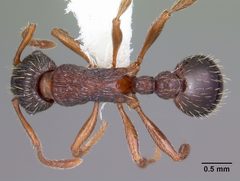
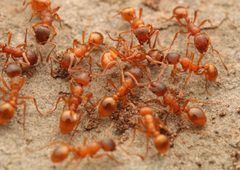
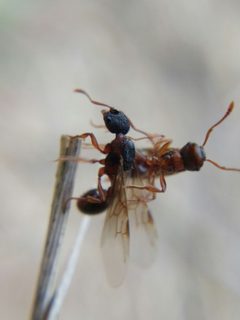
2Myrmicini is a tribe of ants in the Myrmicinae, considered one of the most morphologically primitive tribes within its subfamily. It comprises extant Myrmica and Manica, plus the fossil genera †Plesiomyrmex and †Protomyrmex. The tribe is phylogenetically sister to Pogonomyrmecini, with both tribes sharing a South American origin. Myrmicini exhibits a Holarctic distribution, with Myrmica widespread across Eurasia and North America, and Manica restricted to montane regions of western North America and parts of Eurasia.
Pronunciation
How to pronounce Myrmicini: //mɪrˈmɪsɪˌni//
These audio files are automatically generated. While they are not always 100% accurate, they are a good starting point.
Identification
Myrmicini can be distinguished from similar Myrmicinae tribes by morphologically primitive features including weakly convex propodeal dorsum with short blunt and relatively simple petiolar node structure. Not to be confused with Myrmecinini ( Myrmecina) or Myrmeciini ( Myrmeciinae), which differ in mandibular structure and overall body plan. Within the tribe, Myrmica typically possess more derived features than Manica, including more rounded petiolar nodes and stronger propodeal spines.
Images
Habitat
Montane environments and open with low vegetation. Nests constructed under stones or in underground chambers and galleries, often with vertical crater-like entrances.
Distribution
Holarctic distribution. Myrmica: widespread across Eurasia and North America, with western Nearctic origin inferred for most recent common ancestor. Manica: four in Nearctic (western North America west of 100th meridian and north of 33° N), two species in Palearctic (Europe, Asia Minor, Caucasus, Japan). Fossil record from Late Eocene Baltic amber (ca. 33.9–37.8 Ma) confirms Eurasian presence by Late Eocene.
Life Cycle
Colonies are small in at least some . of some species rarely come to the surface.
Behavior
Subordinate in , with reduced ability to protect resources. One extant , Manica parasitica, is a social () within colonies of other ant species.
Similar Taxa
- MyrmecininiSimilar name; distinguished by Myrmecina with different mandibular and body structure
- MyrmeciiniSimilar name; belongs to Myrmeciinae (), not Myrmicinae, with markedly different including elongated and more primitive overall body plan
- PogonomyrmeciniSister tribe with shared South American origin; Pogonomyrmecini contains harvester ants with more derived and seed-
Misconceptions
The tribe name Myrmicini is frequently confused with Myrmecinini (tribe in Myrmicinae, Myrmecina) and Myrmeciini (tribe in Myrmeciinae, genus ). These are distinct with different type genera and evolutionary histories.
More Details
Evolutionary history
Phylogenomic analyses support a South American origin for the Pogonomyrmecini+Myrmicini clade. The most recent common ancestor of Myrmica is inferred to have inhabited the western Nearctic during the early Miocene, with repeated events across Beringia throughout the Miocene and Pliocene. The most recent common ancestor of Manica possessed a Holarctic range prior to Pliocene vicariance events. The fossil †Manica andrannae from Late Eocene Baltic amber represents a stem lineage of Manica, confirming the originated by at least 50 million years ago.
Fossil record
The tribe is represented by two extinct : †Plesiomyrmex and †Protomyrmex, both described from Eocene deposits. The first definitive Manica fossil, †Manica andrannae, was described in 2023 from Late Eocene Baltic amber using X-ray micro-computed tomography with 3D reconstruction.
Phylogenetic sensitivity
Phylogenomic studies note that tribal topology within Myrmicinae shows high sensitivity to compositional heterogeneity and gene-tree -tree conflict. Single fossil calibration points, such as that for †Manica andrannae, can have broad cascading effects on divergence date estimates across the .
Sources and further reading
- BugGuide
- Wikipedia
- iNaturalist taxon
- NCBI Taxonomy
- Catalogue of Life
- Phylogenomics Resolve the Systematics and Biogeography of the Ant Tribe Myrmicini and Tribal Relationships within the Hyperdiverse Ant Subfamily Myrmicinae.
- The First Fossil Record of the Genus Manica Jurine, 1807 from Late Eocene Baltic Amber and Discussion of the Early Evolution of Myrmicini (Hymenoptera: Formicidae: Myrmicinae).