
Myrmecina
Curtis, 1829
Mite-eating Ants
Species Guides
1- Myrmecina americana(American Mite-eating Ant)
Myrmecina is a of ants in the Myrmicinae containing approximately 51-53 . The genus has a broad geographic distribution spanning North America, Europe, northern Africa, India, Korea, Japan, and Australia. Species exhibit diverse reproductive strategies, including both winged gynomorphs and wingless intermorphs, with some demonstrating polygynous by ergatoid (-like) queens. The 'Mite-eating Ants' suggests a specialized dietary , though this has not been extensively documented.
Pronunciation
How to pronounce Myrmecina: /mɪərməˈsaɪnə/
These audio files are automatically generated. While they are not always 100% accurate, they are a good starting point.
Identification
Distinguished from other myrmicine by the combination of two-segmented petiole and presence of both winged and wingless female reproductive morphs within . The genus Myrmecites from the Green River Formation, while similar in name and placement, is a separate fossil genus and should not be confused with extant Myrmecina. Accurate species-level identification requires examination of and, ideally, colony-level reproductive characteristics.
Images
Appearance
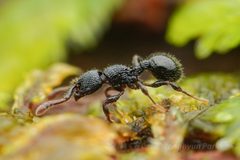
Ants in this possess the general myrmicine body plan with a two-segmented petiole (waist). Fossil evidence from the Middle Eocene (47-52 mya) indicates that extinct members of this lineage, such as Myrmecites rotundiceps, exhibited very short, two-segmented waists that distinguish them from other Eocene ants. Extant show dimorphism in female reproductive , with both winged gynomorphs and wingless intermorphs documented.
Distribution
North America, Europe, northern Africa, India eastward through Korea and Japan, and Australia. The exhibits a disjunct distribution pattern across temperate and tropical regions of multiple continents.
Life Cycle
Colonies reproduce through multiple strategies: some contain winged gynomorphs that undergo dealation (wing shedding) after mating, while others maintain polygynous colonies with multiple ergatoid (-like, wingless) queens. This reproductive flexibility represents an unusual diversification of morphs within the .
Behavior
Virgin females of at least one (M. graminicola) perform inconspicuous 'sexual calling' by depositing on the substrate near themselves rather than engaging in obvious display . The is produced in the poison gland, not the pygidial gland as previously reported for related species. Copulation is brief, lasting 40-60 seconds, which contradicts earlier reports of several-hour durations for this species.
Similar Taxa
- Myrmecites (fossil genus)Similar name and myrmicine placement, but Myrmecites is an extinct from the Middle Eocene known only from fossils, while Myrmecina is extant. The fossil Myrmecites rotundiceps has an unusually short two-segmented waist that distinguishes it from modern Myrmecina.
- Other Myrmicinae generaMany myrmicine share the two-segmented petiole; Myrmecina is distinguished by its particular combination of dimorphism (winged gynomorphs and wingless intermorphs) and specific patterns of usage.
Misconceptions
Earlier literature on Myrmecina graminicola reported copulation durations of several hours and pygidial gland as the source; subsequent laboratory studies demonstrated these were incorrect, with actual copulation lasting 40-60 seconds and poison gland serving as the pheromone source. This highlights the importance of direct observation over anecdotal reports.
More Details
Fossil Record
The has significant paleontological importance. Myrmecites rotundiceps from the Green River Formation (Middle Eocene, 47-52 mya) represents one of the oldest known myrmicine ants in North America, suggesting either a North American origin for the or at least early diversification in this region. This fossil exhibits a unique very short, two-segmented waist not seen in extant .
Reproductive Diversity
The demonstrates remarkable flexibility in reproductive strategies, with documented cases of both monogynous and polygynous colony structures, and the coexistence of winged and wingless morphs. An Indonesian exhibits polygynous by multiple ergatoid queens, while European species maintain winged gynomorphs.
Sources and further reading
- BugGuide
- Wikipedia
- GBIF taxonomy match
- iNaturalist taxon
- NCBI Taxonomy
- Catalogue of Life
- The 2nd-oldest Known Myrmicine Ant | Beetles In The Bush
- Coleoptera | Blog - Part 4
- Mating behavior in the ant, Myrmecina graminicola (Myrmicinae)
- Colony Characteristics of the Indonesian Myrmicine Ant Myrmecina sp. (Hymenoptera, Formicidae, Myrmicinae): Polygynous Reproduction by Ergatoid Queens