
Crematogaster laeviuscula
Mayr, 1870
Shiny Acrobat Ant, Acrobat Ant, Valentine Ant
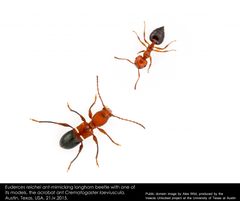
Crematogaster laeviuscula, commonly known as the shiny acrobat or valentine ant, is a of ant in the Crematogaster. The species is notable for its role as a of other insects, including documented on nests. It has been recorded as a significant predator of paper wasp colonies, particularly Polistes exclamans. The species is widespread across North America, with over 5,000 observations documented on iNaturalist.
Pronunciation
How to pronounce Crematogaster laeviuscula: //ˌkrɛmətoʊˈɡæstər leɪˈviːʌskjʊlə//
These audio files are automatically generated. While they are not always 100% accurate, they are a good starting point.
Identification
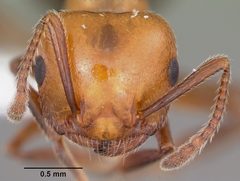
Like other Crematogaster , C. laeviuscula possesses a distinctive -shaped () that can be raised over the when alarmed—this acrobatic posture gives the its . The specific epithet "laeviuscula" (somewhat smooth) suggests relatively smooth body compared to related species. For definitive identification, examination of specific morphological characters including petiole structure and body sculpturing is required.
Images
Distribution
Widespread across North America, ranging from New Jersey south and west to Florida, Indiana, Illinois, Nebraska, Colorado, Arizona, and southern California. The also occurs in Mexico and has been introduced to Hawaii.
Diet
Predatory. Documented to prey on the nests of paper wasps (Polistes exclamans), where it has been observed destroying entire . Also recorded as a of mason wasp (Pachodynerus nasidens) nests, where it breaks into nests to prey on stages.
Behavior
Colony-based foraging with documented nest-raiding against social . have been observed infiltrating paper wasp nests to consume , larvae, and pupae. The exhibits the characteristic acrobat defensive behavior of elevating the when disturbed.
Ecological Role
of other Hymenoptera, particularly social . Acts as a significant source of mortality for paper wasp and mason wasp colonies. May help regulate of these wasp in shared .
Human Relevance
Occasionally a nuisance when nesting in or near structures. Can be a pest of paper wasp colonies in residential areas, though this is generally not considered problematic from a human perspective. The is not known to sting humans aggressively.
Similar Taxa
- Crematogaster ashmeadiOverlapping range in southeastern United States; distinguished by more pronounced sculpturing and different petiole proportions
- Crematogaster lineolataSympatric in eastern North America; requires examination of mesosomal and coloration patterns for separation
- Other Polistes paper wasps may be confused with small by casual observers, but the elbowed , constricted waist with two nodes, and lack of wings distinguish ants
More Details
Predation on Polistes exclamans
Strassmann (1981) documented that Crematogaster laeviuscula can destroy entire of the paper wasp Polistes exclamans, representing a significant mortality factor for this social .
Predation on Pachodynerus nasidens
Eric's blog records acrobat ants (Crematogaster sp., including C. laeviuscula) as of the mason wasp Pachodynerus nasidens, breaking into mud to prey on .
Sources and further reading
- BugGuide
- Wikipedia
- GBIF taxonomy match
- iNaturalist taxon
- NCBI Taxonomy
- Bug Eric: Wasp Wednesday: Polistes exclamans
- 52-million-year-old Beetle Fossil is Oldest Known Practitioner of Myrmecophily
- Bug Eric: Green Lynx Spider
- Bug Eric: Termite Swarms
- How Ants Do Battle: Toxic Sprays, Thick Armor, Overwhelming Numbers, and More
- Bug Eric: February 2011