
Crematogaster crinosa
Mayr, 1862
crinosa-complex Acrobat Ants
Crematogaster crinosa is a of acrobat ant in the tribe Crematogastrini, described by Mayr in 1862. It belongs to the crinosa , a group of closely related Crematogaster species that can be difficult to distinguish morphologically. The species is native to the Neotropics and has been documented in association with various nests as a .
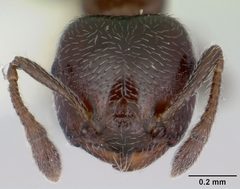
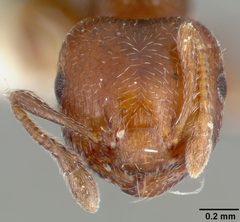
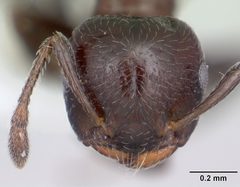
Pronunciation
How to pronounce Crematogaster crinosa: /kɹɛmətəˈɡæstər kraɪˈnoʊsə/
These audio files are automatically generated. While they are not always 100% accurate, they are a good starting point.
Identification
Members of the crinosa complex are characterized by a -shaped that can be raised over the when alarmed, a defining trait of acrobat ants. -level identification within this complex requires examination of specific morphological features such as pilosity patterns and propodeal spine . The complex is noted for being taxonomically challenging due to subtle morphological differences between closely related species.
Images
Distribution
Documented from northern South America including Colombia (Bolívar, Magdalena departments), Ecuador (Reserva Ecológica Arenillas), and extensively across Brazil (Acre, Amazonas, Amapá, Bahia, Ceará, Distrito Federal, Espírito Santo, Goiás, Minas Gerais, Mato Grosso do Sul, Mato Grosso, Pará, Pernambuco, Piauí, Paraná, Rio de Janeiro, Rondônia, Rio Grande do Sul, Santa Catarina, São Paulo states).
Host Associations
- Pachodynerus nasidens - Acrobat ants (Crematogaster sp.) are recorded as of this mason wasp, presumably breaking into nests to prey on stages
- Polistes exclamans - Crematogaster laeviuscula, a congeneric , has been documented destroying paper wasp nests; similar may occur in C. crinosa
Behavior
Has been observed as a of other nests. Related in the are known for their characteristic 'acrobatic' defensive posture where the is raised over the . Some Crematogaster species engage in cooperative foraging and nest defense.
Similar Taxa
- Other Crematogaster crinosa complex speciesMorphologically similar members of the same require detailed examination for accurate identification
- Crematogaster laeviusculaCongeneric with overlapping ecological role as nest ; distinguished by geographic range and subtle morphological features
More Details
Taxonomic status
The iNaturalist database classifies this at 'complex' rank rather than , reflecting ongoing taxonomic uncertainty and the difficulty of distinguishing C. crinosa from closely related species in the crinosa complex. The GBIF and NCBI databases maintain it as an accepted species.
Sources and further reading
- BugGuide
- Wikipedia
- GBIF taxonomy match
- iNaturalist taxon
- NCBI Taxonomy
- Bug Eric: Wasp Wednesday: Polistes exclamans
- 52-million-year-old Beetle Fossil is Oldest Known Practitioner of Myrmecophily
- Bug Eric: Green Lynx Spider
- Bug Eric: Termite Swarms
- How Ants Do Battle: Toxic Sprays, Thick Armor, Overwhelming Numbers, and More
- Bug Eric: February 2011