
Cardiocondyla venustula
Wheeler, 1908
Larger Black Sneaking Ant
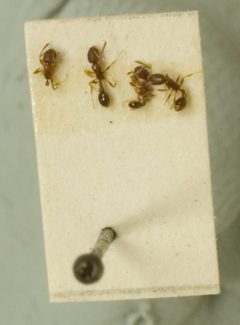
Cardiocondyla venustula is a small myrmicine native to Africa, with introduced in the Caribbean and North America. The belongs to the C. shuckardi group and exhibits an intermediate reproductive strategy among , with wingless males that attack freshly eclosing rivals but rarely engage in lethal combat with established competitors. Instead, males establish and defend small territories within their natal nests. The species shows considerable genetic diversity across its native range, with multiple mtDNA lineages detected in South Africa, Angola, and Côte d'Ivoire that are morphologically and nuclearly similar, indicating a complex taxonomic history.

Pronunciation
How to pronounce Cardiocondyla venustula: /ˌkɑrdioʊˈkɒndɪlə vəˈnʊstjʊlə/
These audio files are automatically generated. While they are not always 100% accurate, they are a good starting point.
Identification
Distinguished from by morphological features typical of the C. shuckardi group; precise diagnostic characters require examination of type material and comparison with related . Genetic data reveal multiple divergent mtDNA lineages that may represent cryptic diversity.
Images
Habitat
Subterranean nesting; colonies occupy underground nests where males establish territorial spaces. Native occur in African savanna and woodland .
Distribution
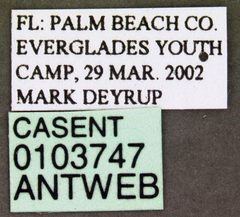
Native to sub-Saharan Africa, with confirmed records from South Africa, Angola, and Côte d'Ivoire. Introduced to Puerto Rico and other Caribbean islands, with additional introductions to Mexico, Cuba, Barbados, Hawaii, and the continental United States.
Behavior
Wingless males exhibit intermediate aggressive between the lethal fighting seen in some and complete mutual observed in others. Males attack and kill freshly eclosing rival males but establish small defended territories within natal nests rather than engaging in deadly combat with competitors. Territorial males have increased contact with female sexuals and higher mating attempt frequencies. Female sexuals show no detectable preference for particular males in controlled choice experiments. This territorial system is hypothesized to be an to seasonal production of large numbers of female sexuals by multiple colony queens.
Ecological Role
Pioneer capable of colonizing disturbed and potentially ant-free ; introduced demonstrate potential on islands and in new regions.
Human Relevance
Accidentally introduced to multiple regions outside native range, including Caribbean islands, Hawaii, and North America, where it has established persistent .
Similar Taxa
- Cardiocondyla pirataBoth belong to Cardiocondyla and share small body size and inconspicuous habits, but C. pirata is distinguished by unique pigmentation pattern with dark stripe across in female and is restricted to the Philippines
- Cardiocondyla shuckardiFellow member of C. shuckardi group with which C. venustula shares phylogenetic affinities and morphological similarities; precise distinctions require detailed examination
- Other C. shuckardi group membersMorphologically and genetically similar within the same clade; C. venustula distinguished by specific male behavioral repertoire and genetic lineage composition
Sources and further reading
- BugGuide
- GBIF taxonomy match
- iNaturalist taxon
- NCBI Taxonomy
- Catalogue of Life
- Uncategorized | Blog - Part 37
- The pirate ant: A new species from the Philippines with a bizarre pigmentation pattern | Blog
- Between fighting and tolerance: reproductive biology of wingless males in the ant Cardiocondyla venustula
- Genetic Diversity in Pioneer Ants: The Cardiocondyla shuckardi Group