
Cardiocondyla obscurior
Wheeler, 1929
Arboreal Sneaking Ant
Cardiocondyla obscurior is a small myrmicine with Indomalayan origins that has achieved distribution as a tramp . It exhibits distinctive reproductive traits including male with both winged and wingless male morphs, and a unique aging strategy termed 'continuusparity' where queens maintain continuous with a peak late in life. The species is primarily arboreal, nesting in plant cavities of low vegetation, and has been introduced to numerous regions including the Americas, Europe, and Asia.
Pronunciation
How to pronounce Cardiocondyla obscurior: /ˌkɑːrdiəˈkɒndɪlə əbˈskjʊriɔr/
These audio files are automatically generated. While they are not always 100% accurate, they are a good starting point.
Identification
Distinguished from by arboreal nesting habits in low vegetation cavities, contrasting with the ground-nesting tendency of most Cardiocondyla . Male with conditional production of winged males under temperature stress is a key diagnostic feature. Cuticular hydrocarbon profiles differ quantitatively and qualitatively between queens and . In introduced ranges, may be confused with other small yellowish tramp ants but can be separated by the combination of arboreal nesting, male morph diversity, and specific CHC profile characteristics.
Images
Appearance
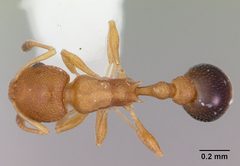
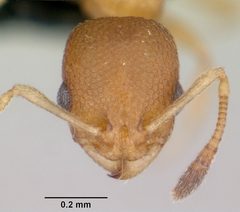
Small with light brown to orange body coloration and darker . are diminutive, consistent with the Cardiocondyla. Queens and workers show quantitative and qualitative differences in cuticular hydrocarbon profiles. Winged males possess wings; wingless ergatoid males lack wings and wings are morphologically distinct from workers.
Habitat
Arboreal; nests in plant cavities of low vegetation. In native range found in tropical forest understory. In introduced ranges has been observed in agricultural areas and urban environments, including outdoor establishment in Mediterranean climates.
Distribution
Native to Indomalayan region (type locality Rica per historical records, though this may reflect early collection rather than true origin). tramp distribution with records from: Central and South America (Brazil: Bahia, Maranhão, Minas Gerais, Mato Grosso; Barbados; Bermuda), North America, Europe (first detected 1999; established outdoors in southern European countries since 2015, including Crete), Asia (Japan, Pakistan, Philippines), and globally in tropical and subtropical regions. studied in laboratory include BR13, BR18 (Brazil) and JP11 (Japan).
Life Cycle
Colony development proceeds through ergonomic phase ( production) followed by reproductive phase. development approximately 5 weeks; male development approximately 3 weeks. Winged reproductives require on average 8.8 days longer for development from to than wingless ergatoid males and workers. Critical stage for morph and determination is end of second larval instar. queen lifespan approximately 25 weeks (highly variable, CV 32.2%). Workers are completely sterile. Queens shift to production of sexual offspring (queens and males) in late life regardless of absolute lifespan or colony size.
Behavior
Exhibits age in with task allocation changing with worker age, mediated by foraging . Workers display aggression toward non-nestmate queens, particularly queens; intraspecific aggression levels correlate with cuticular hydrocarbon profile differences between colonies. appear multicolonial and polydomous. Workers modify larval care in response to environmental stress, triggering development of winged male morphs. Queens nearing death exhibit lethargic behavior, reduced mobility, nest abandonment, and worker harassment.
Ecological Role
As a globally distributed tramp ant, likely contributes to local dynamics through competition and , though specific impacts have not been quantitatively assessed. Introduced generally considered to have limited ecological impact, though targeted studies are lacking.
Human Relevance
Used extensively as a laboratory model organism for studies of aging, reproductive strategies, determination, and social insect . Subject of research on effects of environmental pollutants including titanium dioxide nanoparticles, glyphosate, nicotine, and . documented in agricultural and urban areas; presence in Pakistan represents first record for that country. Not known to cause significant economic damage or pose direct threats to human health.
Similar Taxa
- Cardiocondyla pirata with distinctive pirate-like stripe pigmentation in females; both share male and Philippine distribution, but C. pirata lacks arboreal nesting habit and has unique pigmentation pattern
- Cardiocondyla kagutsuchiSympatric in parts of introduced range; distinguished by different male morph ratios and nest site preferences
- Wasmannia auropunctataSimilar small yellowish often confused in field; distinguished by lack of male , ground-nesting habit, and potent sting
- Plagiolepis alluaudiSimilar small yellow ; distinguished by uniform yellow coloration, lack of male , and different nesting
More Details
Male Polyphenism Mechanism
Winged male production triggered by environmental stress, particularly temperature decrease of approximately 5°C. plays key role in morph determination; treatment of first and second instar larvae with methoprene (juvenile hormone analogue) induces winged morph expression. mediate this developmental switch through altered larval care rather than larvae responding directly to environmental cues.
Aging and Reproductive Strategy
Termed 'continuusparity' - combines continuous with peak late in life, distinct from and strategies. Queens develop massive while still fertile, leading to rapid reproductive death. show same lifespan and aging trajectory as queens despite complete sterility, contradicting typical -worker lifespan divergence in social insects.
Endosymbiont Associations
Candidatus Westeberhardia cardiocondylae and sp. as primary bacterial endosymbionts. densities mediate effects of environmental stressors including , with rifampicin treatment reducing , colony productivity, and male sperm viability through transgenerational effects.
Chemical Ecology
Cuticular hydrocarbon profiles function in nestmate discrimination and intraspecific aggression. Despite status, colonies maintain chemical diversity and aggressive responses to non-nestmates, particularly toward foreign queens with intact CHC profiles; queens with depleted CHC profiles receive minimal aggression.
Sources and further reading
- BugGuide
- Wikipedia
- GBIF taxonomy match
- iNaturalist taxon
- NCBI Taxonomy
- Catalogue of Life
- Uncategorized | Blog - Part 37
- During Quarantine, an Entomologist Takes a Closer Look at a New Invasive Ant Species
- The pirate ant: A new species from the Philippines with a bizarre pigmentation pattern | Blog
- The indispensable soma of Cardiocondyla obscurior ants
- Cardiocondyla obscurior, a new alien ant in Crete (Hymenoptera, Formicidae)
- Late-life fitness gains and reproductive death in Cardiocondyla obscurior ants
- First Record of Cardiocondyla obscurior Wheeler, 1929 (Hymenoptera: Formicidae: Myrmicinae) for Pakistan
- Proximate mechanisms of male morph determination in the ant Cardiocondyla obscurior
- Fitness related effects of titanium dioxide nanoparticles and glyphosate exposure on Cardiocondyla obscurior
- The role of cuticular hydrocarbons in intraspecific aggression in the invasive ant Cardiocondyla obscurior
- Chronic exposure to nicotine in diet enhances the lethal effect of an entomopathogenic fungus in the ant Cardiocondyla obscurior
- Expression of the Foraging Gene Is Associated with Age Polyethism, Not Task Preference, in the Ant Cardiocondyla obscurior
- Endosymbionts mediate the effects of antibiotic exposure in the tramp ant Cardiocondyla obscurior
- Fitness related effects of titanium dioxide nanoparticles and glyphosate exposure on Cardiocondyla obscurior.