
Pheidole obscurithorax
Naves, 1985
Large Imported Big-headed Ant
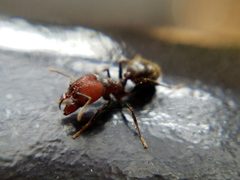
Pheidole obscurithorax is a large, dark, dimorphic native to northern Argentina and Paraguay. It was introduced to Mobile, Alabama in the early 1950s and has since spread along an 80-km-wide coastal band between Alabama and Tallahassee, Florida. The is characterized by dimorphism with enlarged-headed majors and has demonstrated rapid growth in invaded areas, with nest increasing 6.4-fold over two years in Tallahassee. It coexists with the red imported fire ant (Solenopsis invicta) and appears to have minimal negative impact on native ant , being part of a largely ant adapted to disturbed .
Pronunciation
How to pronounce Pheidole obscurithorax: //faɪˈdoʊli ɒbˌskjʊrɪˈθɔːræks//
These audio files are automatically generated. While they are not always 100% accurate, they are a good starting point.
Identification
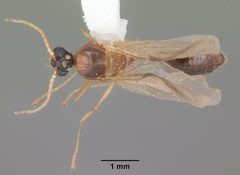
are dimorphic, with major workers possessing disproportionately large compared to minor workers. The is notably large and dark in coloration, reaching up to 6 mm in length. Major workers use their enlarged heads and for defense and prey processing. Nests are conspicuous, with single large openings 1-5 cm wide in soil, often covered by collected leaf material. Distinguished from other Pheidole species by its large size, dark coloration, and association with open, disturbed in the southeastern United States.
Images
Habitat
Open areas in disturbed , particularly roadsides with shorter grass. In its native range, it occupies mature floodplain and open pasture in the Parana River region of northern Argentina and Paraguay. In the introduced range, nest is highest near Pensacola, Florida.
Distribution
Native to northern Argentina and Paraguay. Introduced to the southeastern United States, where it currently occupies an 80-km-wide coastal band between Mobile, Alabama and Tallahassee, Florida. First observed in Mobile, Alabama in the early 1950s; first observed in Tallahassee, Florida in 1998. The range is gradually expanding through natural . GBIF records indicate presence in multiple Brazilian states (Bahia, Maranhão, Minas Gerais, Mato Grosso do Sul, Mato Grosso, Pernambuco, Piauí, Rio Grande do Sul, São Paulo) and the conterminous United States.
Seasonality
Mating occur before dawn after summer rains.
Diet
. Collects a variety of prey including other ants—notably Solenopsis invicta body parts have been found in nest middens. Plant material such as flower petals is consumed less frequently. Uses team transport for large prey items. In urban environments, has been observed to play a key role in food waste detection and removal.
Life Cycle
Colonies contain a single found up to 3 meters below the surface. Small mating observed before dawn after summer rains. Colony excavations reveal single queen per colony.
Behavior
exhibit combined foraging tactics: scouts carry small prey unaided while teams transport large prey whole. Defends prey items from other ants including Solenopsis invicta, with mixed success in battles. Remarkable speed and size of prey handling has been observed. Produces conspicuous soil nests with single large opening often covered by collected material.
Ecological Role
Appears to have little negative effect on it invades. Coexists with Solenopsis invicta. Part of a largely ant community tolerant of highly disturbed . Associated with lower expected at occupied sites (8 versus 16 at equivalent sampling), though this may reflect habitat preference for disturbed areas rather than competitive exclusion. Eight woodland ant species are absent from sites where P. obscurithorax is present. In urban environments, provides services through food waste detection and removal.
Human Relevance
Recognized as a key in detecting and removing food waste in urban areas, contributing to services in densely populated environments. Considered a tramp ant species spread by human activity. Not regarded as a major pest species compared to other ants, with minimal documented negative economic or ecological impact.
Similar Taxa
- Pheidole megacephalaBoth are large, dimorphic Pheidole with enlarged-headed major . P. megacephala is distinguished by its global distribution as one of the world's worst species, broader thermal , and more severe ecological impacts. P. obscurithorax is larger and darker, with a more restricted introduced range in the southeastern United States.
- Solenopsis invictaCo-occurs with P. obscurithorax in the southeastern United States. Both are introduced, soil-nesting ants in disturbed . Distinguished by in S. invicta versus dimorphic workers in P. obscurithorax, and by the sting apparatus present in fire ants.
Sources and further reading
- BugGuide
- GBIF taxonomy match
- iNaturalist taxon
- NCBI Taxonomy
- Catalogue of Life
- Big-headed Ants Are Biggest in Australia Due to Competition
- During Quarantine, an Entomologist Takes a Closer Look at a New Invasive Ant Species
- Fire ant winged reproductives: male and female | Beetles In The Bush
- Hymenoptera | Blog - Part 7
- Bichos Argentinos #2 – Pseudomyrmex sp. | Beetles In The Bush
- Ants in the Nest: A Possible Emerging Pressure on Sea Turtles
- Distribution, spread, and ecological associations of the introduced ant Pheidole obscurithorax in the southeastern United States
- Distribution, spread, and ecological associations of the introduced ant Pheidole obscurithorax in the southeastern United States
- Pheidole obscurithorax Naves, 1985 (Hymenoptera: Formicidae) as a Key Species in Detecting and Removing Food Waste in Urban Areas