
Nylanderia flavipes
(Smith, 1874)
Yellow-footed Ant
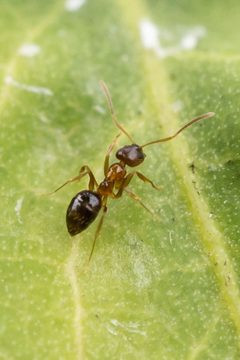
Nylanderia flavipes is a small in the Formicinae, native to Asia and introduced to the Nearctic region including the United States. It was previously classified under the Paratrechina before taxonomic revision. The species serves as a documented for the Gollumiella buffingtoni, with showing unusual and active assistance toward the parasitoid's development. It is one of at least five introduced Nylanderia species established in the Nearctic region.
Pronunciation
How to pronounce Nylanderia flavipes: //nɪˌlænˈdɪəriə ˈflæ.vɪˌpɛs//
These audio files are automatically generated. While they are not always 100% accurate, they are a good starting point.
Identification
Identification to level typically requires examination of male specimens, as of Nylanderia flavipes are morphologically similar to other Nylanderia species. The species was historically classified as Paratrechina flavipes; taxonomic revision moved it to Nylanderia. In the Nearctic region, it is distinguished from native Nylanderia species by its introduced status. Molecular or detailed morphological analysis may be necessary for definitive identification where workers of multiple introduced and native species co-occur.
Images
Appearance
Small with yellowish legs, consistent with the specific epithet 'flavipes' meaning yellow-footed. possess the general typical of Nylanderia: small size, erect hairs on body, and relatively long . Detailed morphological descriptions require examination of or specialized taxonomic literature.
Habitat
Forest edge environments in native range, with nests located under stones. In introduced range, specific preferences are less documented but likely include disturbed and natural habitats suitable for small Formicine ants.
Distribution
Native to Asia (Japan, and likely broader Asian distribution based on historical records as Paratrechina flavipes). Introduced to the Nearctic region, including the conterminous United States. Records from Germany, Spain, United Arab Emirates, and Iran suggest additional introduced or broader native range.
Host Associations
- Gollumiella buffingtoni - Eucharitid ; larvae attach to larvae and enter their bodies; naked pupae are tolerated and transported by N. flavipes
Behavior
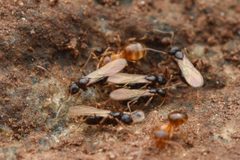
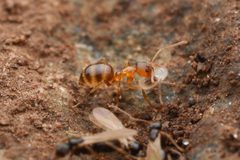
exhibit phoretic transport of on their . Workers tolerate and actively transport naked pupae of the parasitoid Gollumiella buffingtoni within the nest. Workers assist with parasitoid by removing pupal exuvium. Newly emerged parasitoid remain motionless before exiting the nest, suggesting behavioral that may reduce aggression from ants.
Ecological Role
Documented for ant parasitoid wasps, contributing to understanding of - evolutionary adaptations and chemical mimicry. As an introduced in the Nearctic, its ecological impacts on native ant are not well documented.
Human Relevance
One of several introduced Nylanderia in the Nearctic region; not noted as a significant pest or beneficial species in available sources. Taxonomic importance due to historical classification confusion with related species.
Similar Taxa
- Nylanderia vividula are difficult to distinguish morphologically; male specimens required for definitive identification
- Nylanderia terricola are difficult to distinguish morphologically; male specimens required for definitive identification
- Nylanderia bourbonicaAnother introduced Nylanderia in the Nearctic; shares introduced status and similar
- Nylanderia fulvaAnother introduced Nylanderia in the Nearctic; N. fulva (tawny crazy ) is notably and may be distinguished by and
More Details
Taxonomic History
Previously classified as Paratrechina flavipes (Smith, 1874); transferred to Nylanderia following taxonomic revision of the . References to Paratrechina flavipes in older literature (e.g., Ichinose 1986, 1987) refer to this .
Parasitoid Relationship
The association with Gollumiella buffingtoni represents a well-documented case of - integration. The high of N. flavipes toward the parasitoid, including active assistance during , suggests chemical mimicry or other mechanisms of social integration. This system has been studied in Central Japan.
Sources and further reading
- BugGuide
- GBIF taxonomy match
- iNaturalist taxon
- NCBI Taxonomy
- Catalogue of Life
- Ice dams, wet wood, and termites - Reticulitermes flavipes — Bug of the Week
- What lies beneath the mulch? Formosan termite, Coptotermes formosanus, and Eastern subterranean termite, Reticulitermes flavipes — Bug of the Week
- How to raise a crop of termites: Eastern subterranean termites, Reticulitermes flavipes — Bug of the Week
- From the Bug of the Week mailbag, termites or ants? Eastern subterranean termites, Reticulitermes flavipes, or Citronella ants, Lasius sp. — Bug of the Week
- Polydesmida | Beetles In The Bush
- New Method Makes for Faster Genetic ID of Eastern U.S. Termites
- Life history and host relationship of Gollumiella buffingtoni Heraty, 2004 (Hymenoptera, Eucharitidae, Gollumiellinae) with Nylanderia flavipes (Smith, 1874) (Hymenoptera, Formicidae, Formicinae)
- Monograph of Nylanderia (Hymenoptera: Formicidae) of the World, Part II: Nylanderia in the Nearctic