
Nylanderia fulva
(Mayr, 1862)
Tawny Crazy Ant, Rasberry Crazy Ant, Caribbean Crazy Ant, Brown Crazy Ant, Invasive Crazy Ant, Hairy Crazy Ant
Nylanderia fulva, commonly known as the tawny crazy , is an ant native to South America that has become a significant pest in the southern United States. The species is characterized by its erratic, rapid movement patterns and ability to form enormous supercolonies with millions of . It was first reported in the continental United States in 1938 but only recognized as a serious pest in the 1990s in Florida and 2000s in Texas. The ant exhibits a unicolonial social structure in its invasive range, with interconnected nests showing no intraspecific aggression.
Pronunciation
How to pronounce Nylanderia fulva: /nɪˈlændɛriə ˈfʊlvə/
These audio files are automatically generated. While they are not always 100% accurate, they are a good starting point.
Identification
Distinguished from the longhorn crazy ant (Paratrechina longicornis) by its uniform tawny coloration and shorter relative to body length. Separated from Nylanderia pubens, its closely related sister , by molecular characters and subtle morphological differences. The species' erratic movement pattern and dense body setae help distinguish it from other small brown ants. In the field, massive colony size and lack of intraspecific aggression are diagnostic of established . The species does not sting, unlike fire ants (Solenopsis invicta), which it often displaces.
Images
Appearance
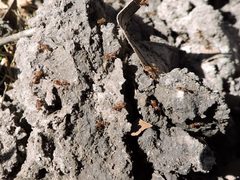
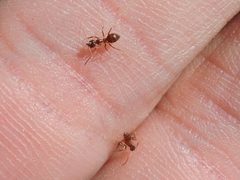
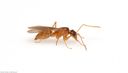
are small, approximately 2-3 mm in length (about 1/8 inch), with a uniform tawny to reddish-brown coloration. The body is covered with dense, pale setae (hairs), giving a slightly fuzzy appearance. have 12 segments with no club. The lacks a stinger and has reduced cuticular hydrocarbon production compared to other ants of similar size. When agitated, workers produce formic acid as a defensive secretion.
Habitat
In its native range, occupies diverse in South America including tropical and subtropical regions. In the range, thrives in both rural and urban environments. Constructs nests in shallow littoral debris, leaf litter, soil cavities, and man-made structures. In North Florida, observed tunneling below ground during winter, a previously undescribed for this . Shows reduced desiccation resistance due to low cuticular hydrocarbon production, limiting distribution in arid environments.
Distribution
Native to South America, with confirmed records from Argentina, Colombia, and Peru; exact native limits remain poorly understood. in the United States: first reported 1938, established in Texas, Louisiana, Mississippi, Alabama, Florida, Georgia, and expanding. Also invasive in continental Ecuador and rural/urban areas of Colombia. Modeled potential distribution suggests high invasion risk in tropical coastal and Amazonian regions with bioclimatic similarity to native range.
Seasonality
In North Florida, reach peak densities from early summer to mid-fall. Colonies likely contract and become localized around permanent nests during seasonal cold months. Year-round activity in warmer parts of range; subterranean tunneling observed during winter cold periods in northern Florida.
Diet
. Liquid diet consists primarily of honeydew from sap-sucking Hemiptera; associated with 28 of across 7 in native range, obtaining honeydew while protecting and transporting these insects. Solid diet includes animal protein from on live , dead crickets, housefly maggots, other insects, spiders, and higher animals. Uses immatures of soil-inhabiting ants as protein food for .
Host Associations
- Wolbachia (supergroup A strains) - endosymbiont73% rate in native Argentine nests; three independent horizontally transmitted infections identified
- Homoptera (28 species across 7 families) - mutualismhoneydew producers protected, transported, and installed on plants by ants
- Atta spp. (leafcutting ants) - competition/displacementdisplaced by N. fulva in invaded areas
- Solenopsis invicta (red imported fire ant) - competition/displacementdisplaced in range; N. fulva detoxifies fire venom using cuticular secretions
- Solenopsis geminata - competition/displacementdisplaced in native and ranges
- Azteca spp. - competition/displacementdisplaced in invaded areas
- Camponotus senex - reliable index of N. fulva absence in coffee plantations
- Myrmecomorba nylanderiae - potential microsporidian under investigation as agent
- Pseudacteon spp. - potential phorid fly under investigation as agents
Life Cycle
Colonies are polygynous and polydomous, containing up to hundreds of reproductive queens and thousands to millions of . Social organization is multicolonial in native range and supercolonial in range, with interconnected nests exchanging unrelated individuals without aggression. occurs in both native and invasive ; not parthenogenetic. Queens and male present in colonies. present year-round in active colonies.
Behavior
Exhibits rapid, erratic, unpredictable movement when disturbed—hence
Ecological Role
pest that dramatically reduces diversity in invaded areas, particularly native . Displaces both native and other invasive ants including the red imported fire ant. Functions as a significant engineer through massive colony construction and modification of soil and litter . Acts as a keystone mutualist with honeydew-producing Hemiptera, altering plant-insect interactions. High densities can disrupt pollination networks and . Potential to facilitate plant transmission through Hemiptera associations.
Human Relevance
Significant economic and nuisance pest. Swarms into electrical equipment causing short-circuits and thousands of dollars in damage to infrastructure, appliances, and electronics. render yards uninhabitable due to overwhelming numbers. Agricultural pest in sugarcane and other crops. Displaces fire ants, leading to ironic nostalgia for previous pest . Difficult to control with conventional ; current management relies on chemical control with limited success. agents under investigation include Pseudacteon flies, Myrmecomorba nylanderiae microsporidian, and a novel polynucleotide virus.
Similar Taxa
- Paratrechina longicornis (longhorn crazy ant)Shares erratic movement pattern but distinguished by longer , darker coloration, and different body proportions
- Nylanderia pubensSister with similar appearance; separated by molecular and subtle morphological characters; taxonomic identity only recently clarified
- Solenopsis invicta (red imported fire ant)Often displaced by N. fulva; distinguished by stinger presence, different coloration, and mound-building
More Details
Chemical Defense
When agitated, produce formic acid as a defensive secretion. Researchers aspirating large numbers report sour taste and burning sensation in throat, requiring collection of smaller groups to reduce agitation.
Supercolony Genetics
Despite acting as a supercolony across wide geographic with no intraspecific aggression, high-resolution SNP analysis reveals genetic substructure among US , with differentiation between Texas, Louisiana, Alabama, Mississippi, Georgia, and Florida. Port city populations most closely related to Buenos Aires, Argentina, suggesting multiple introduction .
Sexually Antagonistic Selection
Genomic region under sexually antagonistic selection identified, with distinct differentially selected in males versus females. Males carry only subset of alleles present in ; females reliably heterozygous with one allele from male gene pool and different maternal allele.
Thermoregulatory Behavior
Unlike Solenopsis invicta, which tunnels more at cooler temperatures, N. fulva shows highest tunneling performance at warmer temperatures (20°C) but retains capacity to tunnel at 15°C, confirming cold avoidance through subterranean tunneling.
Cuticular Hydrocarbon Reduction
Exhibits greatly reduced cuticular hydrocarbon production compared to other ants of similar body size, explaining both reduced desiccation resistance and impaired nestmate recognition that facilitates supercolony formation.
Sources and further reading
- BugGuide
- GBIF taxonomy match
- iNaturalist taxon
- NCBI Taxonomy
- Catalogue of Life
- How Ants Do Battle: Toxic Sprays, Thick Armor, Overwhelming Numbers, and More
- How One Entomologist Followed a Passion to Understand Insect Interactions
- Crazy Ant Populations Growing in Texas and Louisiana
- Jocelyn Holt, Ph.D. - Entomology Today
- Bug Eric: Two-spotted Cobweb Weaver and kin
- Seeding for Success - Buglife Blog - Buglife
- Wolbachia Infection in Native Populations of the Invasive Tawny Crazy Ant Nylanderia fulva
- Habitos Alimenticios Y Relaciones Simbioticas de la "hormiga Loca" nylanderia Fulva Con Otros Artropodos
- Tunneling Performance Increases at Lower Temperatures for Solenopsis invicta (Buren) but not for Nylanderia fulva (Mayr)
- Riesgo de invasión de la hormiga loca <i>Nylanderia fulva</i> (Hymenoptera: Formicidae) en Ecuador Risk of invasion of the crazy ant <i>Nylanderia fulva</i> (Hymenoptera: Formicidae) in Ecuador
- Development of a Set of Microsatellite Markers to Investigate Sexually Antagonistic Selection in the Invasive Ant Nylanderia fulva
- Reduced Cuticular Hydrocarbon Production in the Ant, Nylanderia fulva, Is Associated with Low Desiccation Resistance and Lack of Intraspecific Aggression in Its Invasive Range
- Honeydew-Producing Hemipterans in Florida Associated withNylanderia fulva(Hymenoptera: Formicidae), an Invasive Crazy Ant
- How Homogenous is a Supercolony? High-Resolution Sequencing Revels Population Genetic Structure in the Introduced Range of Tawny Crazy Ant (Nylanderia fulva (Mayr): Hymenoptera: Formicidae)
- A Review of the Tawny Crazy Ant, Nylanderia fulva, an Emergent Ant Invader in the Southern United States: Is Biological Control a Feasible Management Option?
- First Record of Invasive Tawny Crazy Ant Nylanderia fulva (Mayr) (Hymenoptera: Formicidae) in Continental Ecuador and Notes on Its Ecology in Sugarcane Crops
- High-Resolution Population Genetic Structure of Tawny Crazy Ant (Nylanderia fulva Mayr: Hymenoptera: Formicidae) from the Origin in South America and Introduced Regions of the United States