
Camponotus socius
Roger, 1863
Sandhill Carpenter Ant
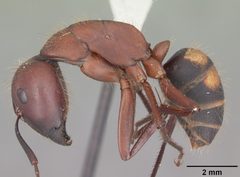
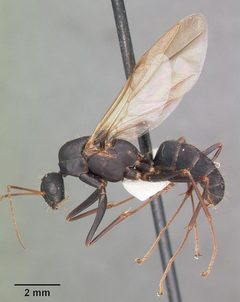
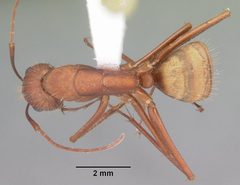
A large carpenter ant native to the southeastern United States, well-adapted to sandy soils of xeric woodlands. Exhibits polymorphic with distinctive coloration including variegated banding. Notable for ground-nesting unusual among Camponotus , constructing deep nests with satellite colonies. Activity is primarily , with midday retreat during hot periods.
Pronunciation
How to pronounce Camponotus socius: /ˌkæmpəˈnoʊtəs ˈsoʊsiəs/
These audio files are automatically generated. While they are not always 100% accurate, they are a good starting point.
Images
Habitat
Xeric sandhill woodlands and upland oak forests of the southeastern coastal plain. Requires well-draining sandy soils with partial to extensive shade coverage. Nests located at tree lines in semi-open areas, sometimes in dense Scrub Palmetto fields. Absent from most developed areas near human habitation.
Distribution
Southeastern United States: Georgia, Alabama, Florida, North Carolina, South Carolina, and Mississippi. Type locality originally described as Brazil (Amazonas) is considered erroneous; exhibits traits consistent with native North American origin.
Seasonality
Reproductive eclose by midsummer; occur August through early November. period extends 2–3 months in northern range. activity peaks in early morning and late evening; midday retreat during hottest hours, though shaded colonies may remain active longer.
Diet
opportunist. prey upon or scavenge arthropods, forage for honeydew from sap-sucking hemipterans on native shrubs, and have been observed feeding on lizard or bird for urea content.
Life Cycle
Colonies overwinter reproductive , rearing into following year. Queens are fully claustral, excavating founding chambers the morning after , then remaining for half a month to three months before raising first . Each colony produces few hundred annually; first largest, subsequent flights smaller.
Behavior
Scout ants deposit material as chemical sign posts around food sources and lay hindgut trails from food to nest; mass foraging organized by individual recruiting ants. Inside nest, recruiting ants perform 'waggle' motor display (0.5–1.5 seconds, 6–12 strokes/second) facing nestmates -on to stimulate up to ~30 ants successively. During nest site recruitment, display becomes more 'jerking', males are recruited, and non-responding nestmates are carried. actively move between satellite nests. Excavating workers carry material far from nest to avoid mound building, depositing refuse irregularly near entrance.
Ecological Role
Important component of undisturbed sandhill ; locally abundant in suitable . Contributes to soil turnover through nest excavation.
Human Relevance
Not a structural pest despite being a carpenter ant; nests exclusively in sandy soils rather than wood. Seldom encountered due to preference for undisturbed and absence from most developed areas.
Similar Taxa
- Camponotus floridanusOverlaps in range (Florida); distinguished by arboreal nesting in wood and structural pest status, versus ground-nesting in sand for C. socius
- Camponotus pennsylvanicusSimilar large size and ; distinguished by black coloration, wood-nesting habit, and broader eastern distribution
- Camponotus sericeiventrisSimilar variegated appearance; distinguished by golden-silvery , arboreal tropical distribution, and acute pronotal spines
Misconceptions
Despite being a carpenter ant, does not damage homes or wooden structures. The type locality of Brazil is erroneous; the is native to North America.
Sources and further reading
- BugGuide
- Wikipedia
- GBIF taxonomy match
- iNaturalist taxon
- NCBI Taxonomy
- Carpenter ants here and there: Camponotus spp. — Bug of the Week
- Ant bodyguards here and there: Odorous house ants, Tapinoma sessile, and carpenter ants, Camponotus — Bug of the Week
- Big black ants in the home: Carpenter ants, Camponotus spp. — Bug of the Week
- Formicidae | Beetles In The Bush | Page 2
- Bichos Argentinos #10 – Friday Formicine | Beetles In The Bush
- Amped-Up Ants: Caterpillars' Sugary Treats Earn Carpenter Ant Care
- Recruitment behavior in Camponotus socius (Hym. Formicidae)