
Camponotus caryae (Fitch, 1855)
(Fitch, 1855)
Walnut Carpenter Ant
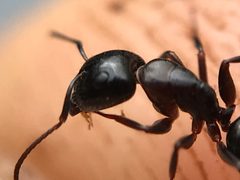
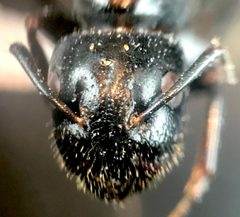
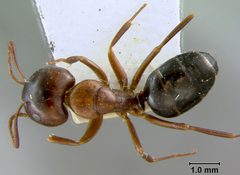
Camponotus caryae is a of carpenter ant in the Camponotus, commonly known as the Walnut Carpenter Ant. It is native to eastern North America, with records from the eastern United States and eastern Canada, and has also been reported from Mexico (Nuevo León and Chihuahua). There are unconfirmed reports of its presence in parts of the western United States, Spain, Italy, and Bulgaria. Like other carpenter ants, it nests in wood and is associated with hickory and walnut trees.
Pronunciation
How to pronounce Camponotus caryae (Fitch, 1855): //ˌkæmpəˈnoʊtəs ˈkæri.aɪ//
These audio files are automatically generated. While they are not always 100% accurate, they are a good starting point.
Images
Habitat
Nests in dead wood, particularly associated with hickory (Carya) and walnut (Juglans) trees. Primary colonies occur in decaying stumps, fallen wood, and hollow trees with high moisture levels. Satellite colonies may establish in moist wood of structures.
Distribution
Eastern United States, eastern Canada, Mexico (Nuevo León, Chihuahua). Unconfirmed reports from western United States, Spain, Italy, and Bulgaria.
Host Associations
- Carya - nesting association epithet 'caryae' refers to hickory ; nests commonly found in hickory wood
- Juglans - nesting association 'Walnut Carpenter Ant' indicates association with walnut trees
Similar Taxa
- Camponotus pennsylvanicusBoth are large black carpenter ants in eastern North America; C. caryae distinguished by association with hickory/walnut and subtle morphological differences
- Camponotus chromaiodesSimilar size and coloration; C. caryae typically distinguished by tree preference and geographic distribution
More Details
Etymology
The epithet 'caryae' derives from the Carya (hickory), reflecting this 's close association with hickory trees
Sources and further reading
- BugGuide
- Wikipedia
- GBIF taxonomy match
- iNaturalist taxon
- Carpenter ants here and there: Camponotus spp. — Bug of the Week
- Ant bodyguards here and there: Odorous house ants, Tapinoma sessile, and carpenter ants, Camponotus — Bug of the Week
- Gall darn it! Gall insects on hickory, oak, and elm, Phylloxera caryaecaulis, Andricus palustris, Colopha ulmicola — Bug of the Week
- Big black ants in the home: Carpenter ants, Camponotus spp. — Bug of the Week
- The “silky-bellied humpbacked” ant | Beetles In The Bush
- Bichos Argentinos #10 – Friday Formicine | Beetles In The Bush