
Camponotus atriceps
(Smith, 1858)
Tropical Carpenter Ant
Camponotus atriceps is a large carpenter ant to the Americas, ranging from the southern United States through Central and South America. In the Amazon region, it has been documented attacking colonies of (Melipona flavolineata and M. fasciculata), destroying hives and consuming when food resources are scarce. The species occupies diverse moist forested from sea level to 2,290 meters elevation. Research in Brazil has demonstrated that empty hive 'trap boxes' can attract these ants, providing a non-chemical control method for managed colonies. of this species have been shown to bioaccumulate heavy metals, indicating potential use as environmental indicators.
Pronunciation
How to pronounce Camponotus atriceps: /ˌkæmpəˈnoʊtəs ˈætrɪsɛps/
These audio files are automatically generated. While they are not always 100% accurate, they are a good starting point.
Identification
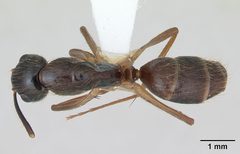
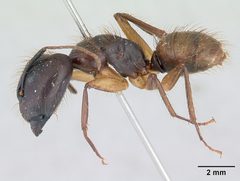
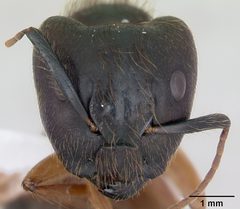
Distinguished from other large black carpenter ants by smooth thoracic profile (no distinct dent in when viewed in profile), unlike field ants (Formica spp.) which show a noticeable thoracic constriction. The shows considerable size variation among , with major workers substantially larger than minors. Specific identification from similar Camponotus species requires examination of pilosity patterns and other fine morphological characters not reliably described in available sources.
Images
Habitat
Occupies moist forested including wet lowland rainforest, tropical rainforest, pine-oak forest, wet montane forest, and mature wet forest. Elevation range spans from near sea level to 2,290 meters.
Distribution
to the Americas. Documented from United States (southern regions), Mexico, Central America, and throughout South America including Brazil, Colombia, Peru, and Argentina. GBIF records indicate presence across most Brazilian states and Colombian departments.
Diet
, feeding on other arthropods, plant material including nectar and seeds, and honeydew from sap-sucking insects. In the Amazon region, has been observed consuming of (Melipona spp.) when food is scarce.
Behavior
Exhibits aggressive predatory toward colonies when food resources are limited, destroying hives and consuming . are attracted to empty hive trap boxes, a behavior exploited for non-chemical control in managed operations.
Ecological Role
Functions as a scavenger and in forest . Potential bioindicator for heavy metal environmental based on documented bioaccumulation in . Plays role as nest competitor and predator of native bees in managed and wild settings.
Human Relevance
Pest of managed colonies in the Amazon region. Research has developed trap box methods using this ' attraction to hive materials as a non-chemical control alternative. bioaccumulate heavy metals, suggesting utility for environmental monitoring. One accepted (C. a. nocens) exists. Associated and documented in related include Microdon fulgens, Myrmecophila pergandei, Alachua floridensis, Obeza floridana, and the Myrmecoblatta wheeleri.
Similar Taxa
- Camponotus pennsylvanicusSimilar large black carpenter ant ; distinguished by geographic range (primarily North America) and specific pilosity patterns
- Camponotus sericeiventrisSimilar arboreal nesting habit and large size; distinguished by golden and acute pronotal spines
- Camponotus musSimilar black coloration and bulbous ; distinguished by obtuse humeral angles and smaller size
More Details
Taxonomic History
Previously referred to as C. abdominalis; one accepted C. a. nocens Wheeler, 1911 recognized
Control Methods
Trap boxes placed in communal shelters of colonies exploit attraction of C. atriceps to hive materials, offering efficient non-chemical control for managed operations
Sources and further reading
- BugGuide
- Wikipedia
- GBIF taxonomy match
- iNaturalist taxon
- NCBI Taxonomy
- Bees Are Your Buddies; Ants Are Your Friends | Bug Squad
- Got an Ant Question? Ask Away at UC Davis Biodiversity Museum Day | Bug Squad
- Carpenter ants here and there: Camponotus spp. — Bug of the Week
- Ant bodyguards here and there: Odorous house ants, Tapinoma sessile, and carpenter ants, Camponotus — Bug of the Week
- Big black ants in the home: Carpenter ants, Camponotus spp. — Bug of the Week
- Formicidae | Beetles In The Bush | Page 2
- Bioaccumulation of Heavy Metals in the Bodies of Workers of Camponotus Atriceps And Dorymyrmex Brunneus (Hymenoptera, Formicidae): An Exploratory Study