
Pristaulacus fasciatus
(Say, 1829)
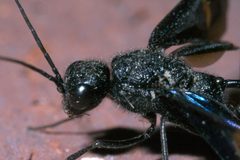
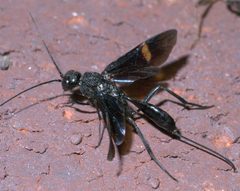
Pristaulacus fasciatus is a of aulacid in the Aulacidae, found in North America. These wasps target wood-boring larvae, particularly longhorned beetles (Cerambycidae) and jewel beetles (Buprestidae), as well as wood wasps in the family Xiphydriidae. Females are larger than males, averaging around 16 mm in body length compared to 13 mm for males. The species is rarely encountered but can be found by searching cut wood and logs where their occur.
Pronunciation
How to pronounce Pristaulacus fasciatus: //prɪs.taʊˈleɪ.kəs ˌfæ.siˈeɪ.təs//
These audio files are automatically generated. While they are not always 100% accurate, they are a good starting point.
Identification
Distinguished from ichneumon wasps by the high attachment of the on the , short neck behind the , and sinuous (curved) ovipositor. Separated from the related Aulacus by larger body size—Pristaulacus are typically larger than Aulacus species. Within Pristaulacus, P. fasciatus is identified by distribution and ; P. rufitarsis has reddish . Superficially resembles stinging spider wasps (Pompilidae) in and appearance, possibly participating in a mimicry ring.
Images
Appearance
Medium-sized with body length averaging 16 mm in females and 13 mm in males. The attaches high on the , creating a distinctive profile. A short "neck" is present behind the . The ovipositor is thin, somewhat sinuous (not straight), and guided by grooves on the inner surface of the hind . are long and used to probe deeply into wood crevices. Wings are present in both sexes.
Habitat
Associated with cut or damaged living wood, including logs, slash piles, and trees with broken limbs. Found in deciduous forest , particularly where Pin Oak and other hardwoods occur. Females search bark crevices and wood cracks for larvae.
Distribution
North America, primarily from eastern Texas and Nebraska eastward. Absent from most of the southeastern United States and Canada. One record exists from New Mexico on iNaturalist. Westernmost records from the eastern deciduous forest fringe in Kansas.
Seasonality
Active from late July through mid-August based on observational records. Likely active earlier in summer as well, coinciding with availability of wood-boring in freshly cut wood.
Host Associations
- Cerambycidae (longhorned beetles) - of larvaeprimary group
- Buprestidae (jewel beetles) - of larvaewood-boring such as Chrysobothris
- Xiphydriidae (wood wasps) - of larvaelarval wood wasps in wood
Life Cycle
Females locate larvae by haltingly across logs and inserting deeply into cracks and crevices, apparently detecting hosts chemically or physically. Upon locating a host, the female inserts her ovipositor into the wood to parasitize the larva. Developmental stages within host unknown; likely follows typical pattern of , larva, pupa, and . Males possibly mate away from host logs, as only females have been observed at host sites.
Behavior
Females exhibit distinctive searching : slowly across logs with slight abdominal bobbing and slow wing rowing. This movement pattern resembles that of spider wasps. When searching, females probe every crack and crevice with their . Once a is located, females commence oviposition, inserting the ovipositor deep into wood. All observed specimens at host sites have been female, suggesting sexual segregation during host searching.
Ecological Role
of wood-boring insects, contributing to of longhorned beetles, jewel beetles, and wood wasps. Part of the of insects exploiting freshly cut or damaged wood resources. May serve as a model for mimicry by or of other .
Human Relevance
Minor relevance to humans. May be encountered by entomologists, foresters, or homeowners dealing with storm-damaged trees or cut wood. The was documented following a tree limb failure event, suggesting that natural disturbances that create cut wood may increase local abundance.
Similar Taxa
- Ichneumonidae (ichneumon wasps)Superficially similar in appearance and use, but distinguished by straight ovipositor, different abdominal attachment, and lack of short neck
- Pompilidae (spider wasps)Similar slow, deliberate with wing rowing and abdominal bobbing; possible mimicry relationship
- Aulacus (other aulacid genus)Same but typically smaller body size; Pristaulacus are larger
- Pristaulacus rufitarsisCongeneric distinguished by reddish and different geographic distribution (documented from Colorado)
More Details
Mimicry
Pristaulacus fasciatus may participate in a small mimicry ring with spider wasps (Pompilidae), sharing similar body form and that could deter .
Sexual dimorphism in behavior
Observational toward females at sites suggests males may not search for hosts directly, or may mate at locations away from wood resources.
Collection history
Historically collected in Cincinnati, Ohio and Colorado, with recent documentation from Kansas expanding the known western range of the in the eastern deciduous forest.
Sources and further reading
- BugGuide
- Wikipedia
- GBIF taxonomy match
- iNaturalist taxon
- NCBI Taxonomy
- Catalogue of Life
- Bug Eric: Wasp Wednesday: Aulacids
- What do insects do in winter? Migrants in the DMV: Common Buckeye, Junonia coenia, Variegated Fritillary, Euptoieta Claudia, Painted Lady, Vanessa cardui, Large Milkweed bug, Oncopeltus fasciatus — Bug of the Week
- Bugs in Orange and Black II: Large milkweed bug, Oncopeltus fasciatus — Bug of the Week
- Orange and Black II: Milkweed leaf beetle, Labidomera clivicollis; Oleander aphid, Aphis nerii; Milkweed Bug, Oncopeltus fasciatus; Monarch, Danaus plexippus — Bug of the Week
- Bugs in orange and black - Monarch butterfly, Danaus plexippus Milkweed Bug - Oncopeltus fasciatus; Milkweed tiger moth, Euchaetes egle — Bug of the Week
- Orange and Black Bugs- Milkweed leaf beetle, Labidomera clivicollis; Oleander aphid, Aphis nerii; Milkweed Bug - Oncopeltus fasciatus; Monarch butterfly, Danaus plexippus — Bug of the Week