
Pristaulacus
Kieffer, 1900
Species Guides
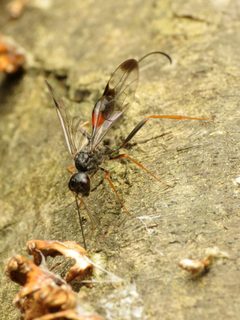
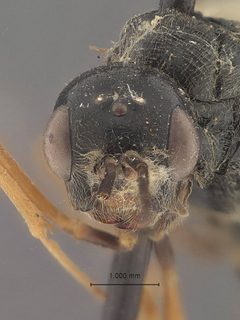
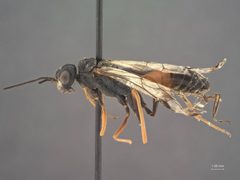
13Pristaulacus is a of aulacid wasps containing more than 190 described . These are specialized on wood-boring beetles, particularly cerambycid and buprestid larvae, and are closely allied to ensign wasps (Evaniidae) and carrot wasps (Gasteruptiidae) within the superfamily Evanioidea. They are most commonly encountered in association with freshly cut or damaged wood where their occur.
Pronunciation
How to pronounce Pristaulacus: //praɪˈstɔːləkəs//
These audio files are automatically generated. While they are not always 100% accurate, they are a good starting point.
Identification
Distinguished from superficially similar ichneumon wasps by the downcurved ovipositor tip and the high attachment of the to the . The short 'neck' behind the and sinuous (not straight) ovipositor separate them from other . Within Aulacidae, Pristaulacus are generally larger than those of the Aulacus. Females are more frequently observed than males, which may mate away from sites.
Images
Habitat
Found in association with freshly cut timber, logging slash piles, and damaged or dying trees. Occurs in both coniferous and deciduous forest systems. The Miocene fossil record indicates long-term association with montane forest containing fir (Abies).
Distribution
distribution across all continents except Antarctica. Palaearctic documented from Europe, North Africa, the Middle East (Lebanon, Syria), and Japan. Afrotropical species occur in South Africa, Zimbabwe, and Mozambique. In North America, occurs from eastern Texas and Nebraska eastward, with records from Colorado and Kansas; appears absent from most of the southeastern United States and Canada.
Seasonality
activity coincides with availability of wood-boring in freshly cut or damaged wood. In Kansas, females observed from late July through mid-August. Activity likely varies regionally with host beetle and logging or forest disturbance patterns.
Host Associations
- Cerambycidae - Larvae of longhorned beetles are primary
- Buprestidae - Larvae of jewel beetles are primary
- Xiphydriidae - Larval wood wasps recorded as
Life Cycle
Females locate larvae in wood by inserting deeply into bark crevices and cracks, apparently detecting hosts chemically or physically. Upon locating a host, the female drills into wood with her ovipositor, guided by grooves on the inner surface of the hind , and deposits an on or near the host larva. The larva develops as an internal of the larva. Developmental timing presumably tracks host larval development within wood.
Behavior
Females walk haltingly across log surfaces while bobbing the slightly and slowly rowing the wings. They probe every available crack and crevice with their , inserting them deeply in search of . Once a host is located, females commence oviposition immediately. Pristaulacus fasciatus may participate in a mimicry ring with spider wasps (Pompilidae) based on similar gait and wing movements. Males are rarely observed at host sites, suggesting mating occurs elsewhere.
Ecological Role
Specialized regulating of wood-boring beetles. Acts as a natural agent in forest , particularly in response to disturbance events such as logging, windthrow, or fire that create fresh wood substrate for beetles. Abundance of aulacid wasps indicates active wood-boring and contributes to nutrient cycling in forest systems by influencing beetle .
Human Relevance
Beneficial insects in forestry contexts due to of wood-boring beetles, some of which are economically important pests. Their presence indicates healthy forest function and active - relationships. Occasionally encountered by entomologists and naturalists at logging operations or following storm damage to trees. No negative impacts on humans recorded; females possess ovipositors but do not sting.
Similar Taxa
- AulacusOther in Aulacidae; typically smaller than Pristaulacus, with subtle morphological differences in wing venation and body proportions
- IchneumonidaeSuperficially similar with long ovipositors, but have straight (not downcurved) ovipositors and abdominal attachment at lower position on
- EvaniidaeRelated in Evanioidea with similar high abdominal attachment, but have highly compressed, flag-like and are associated with rather than wood-boring beetles
- GasteruptiidaeRelated in Evanioidea with similar body plan, but parasitize bees and in stems and twigs rather than wood-boring beetles
More Details
Fossil Record
The first Miocene representative of Pristaulacus was described from the Late Miocene diatomitic maar of Sainte-Reine, Cantal, France. This fossil is phenetically similar to extant P. barbeyi, indicating long-term morphological stability and association with montane coniferous forests over approximately 5-6 million years.
Taxonomic History
The was established by Kieffer in 1900. Multiple regional revisions have been published, including treatments of Palaearctic (21 valid ), Afrotropical (4 species), and Pristaulacus compressus group species. Several synonymies have been resolved, and new species continue to be described from under-sampled regions.
Sources and further reading
- BugGuide
- Wikipedia
- GBIF taxonomy match
- iNaturalist taxon
- NCBI Taxonomy
- Catalogue of Life
- Bug Eric: Wasp Wednesday: Aulacids
- Bug Eric: Beetle Bonanza
- Revision of the Palaearctic species of Pristaulacus Kieffer, 1900 (Hymenoptera: Aulacidae)
- Revision of the Afrotropical species of Pristaulacus Kieffer, 1900 (Hymenoptera: Aulacidae)
- Systematic revision of the sibling species belonging to the Pristaulacus compressus group (Hymenoptera: Aulacidae)
- The first occurrence of the genus Pristaulacus from the Late Miocene diatomitic maar of Sainte-Reine, Cantal, France (Hymenoptera, Aulacidae)