
Anacharitinae
Genus Guides
1Anacharitinae is a of small within Figitidae. Members are known to attack , specifically larvae of Syrphidae (hoverflies) and Chrysopidae (lacewings). This subfamily comprises approximately 100 across four : Anacharis, Aegilips, Callaspidia, and Xyalaspis. The group has a worldwide distribution with greatest diversity in temperate regions.
Pronunciation
How to pronounce Anacharitinae: //ænəˈkærɪtaɪniː//
These audio files are automatically generated. While they are not always 100% accurate, they are a good starting point.
Identification
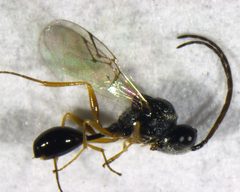
Anacharitinae can be distinguished from other Figitidae by the combination of: reduced wing venation with a distinctively shaped pterostigma; short, stocky body form with a broad connection between and ; and with 13 segments in females, 14 in males. The pronotum extends backward to the tegulae. Unlike many other figitid , Anacharitinae lack the deep constriction between mesosoma and metasoma seen in Eucoilinae.
Images
Distribution
Recorded from all major biogeographic regions including Nearctic, Palearctic, Neotropical, Afrotropical, Oriental, and Australasian zones. is highest in the Holarctic region.
Host Associations
- Syrphidae - of larvaehoverfly larvae ( )
- Chrysopidae - of larvae larvae ( )
Ecological Role
Anacharitinae function as tertiary consumers in -based . By parasitizing the larvae of aphidophagous hoverflies and lacewings, they may indirectly influence aphid and efficacy. This places them at the fourth in many agricultural and natural systems.
Human Relevance
Potential relevance to programs targeting aphids, though their net effect is ambiguous—by suppressing , they may reduce rather than enhance aphid control. Not commonly used in commercial biocontrol.
Similar Taxa
- EucoilinaeAlso small figitid , but Eucoilinae have a deeply constricted petiole (-waisted appearance), attack Diptera (often in different ), and generally have more complex wing venation.
- CharipinaeAnother Figitidae ; Charipinae are hyperparasitoids of aphids via primary , not direct parasitoids of predatory larvae. Charipinae also tend to have reduced wing venation but differ in antennal structure and relationships.