
Phylloteras rubinum
(Gillette, 1888)
Phylloteras rubinum is a cynipid gall wasp originally described as Biorhiza rubinus by Gillette in 1888. It belongs to the Phylloteras, which comprises gall-forming associated with oak trees (Quercus). As a member of the Cynipidae , it induces characteristic plant galls during its . The has been documented through 477 iNaturalist observations, indicating it is moderately well-recorded.
Pronunciation
How to pronounce Phylloteras rubinum: /fɪˈlɒtərəs ruːˈbɪnəm/
These audio files are automatically generated. While they are not always 100% accurate, they are a good starting point.
Identification
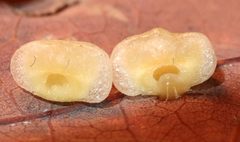
Distinguishing Phylloteras rubinum from requires examination of gall and association, as are minute and morphologically similar. The is associated with specific gall forms on oak leaves. Identification to species level typically requires knowledge of cynipid and may necessitate microscopic examination or reference to .
Images
Appearance
Small , typical of cynipid gall wasps. are minute, with reduced wing venation characteristic of the . Coloration details are not well-documented in available sources.
Habitat
Associated with oak-dominated , including deciduous forests, woodlands, and areas with Quercus trees. The presence of suitable host oaks is the primary habitat requirement.
Distribution
North America. Documented across the range of its oaks, with iNaturalist records distributed primarily in the United States.
Seasonality
timing is linked to oak . Gall formation occurs during the growing season when oaks are in leaf.
Host Associations
- Quercus - Gall formation on oak leaves
Life Cycle
As with other Phylloteras , the involves gall induction on oak leaves. The likely exhibits between sexual and agamic forms, a common trait in Cynipidae, though specific details for this species are not well-documented.
Ecological Role
Acts as a gall-former on oaks, creating plant structures that provide microhabitats for other organisms. Cynipid galls can support and .
Human Relevance
No direct economic significance. Of interest to entomologists and natural historians studying gall-forming insects and oak-associated biodiversity.
Similar Taxa
- Phylloteras poculumCongeneric also forming galls on oaks; differentiation requires gall and examination
- Phylloteras cinctumAnother oak gall-former in the same with potentially overlapping distribution
- Biorhiza pallidaFormerly congeneric (as Biorhiza rubinus); shares oak gall association but differs in gall
More Details
Taxonomic History
Transferred from Biorhiza to Phylloteras, reflecting refined understanding of cynipid and gall associations.
Observation Data
The 477 iNaturalist observations suggest this is regularly encountered by naturalists, though identification reliability varies.