
Neuroterus quercusverrucarum
(Osten Sacken, 1861)
oak flake gall wasp
Neuroterus quercusverrucarum is a of gall wasp in the Cynipidae that induces distinctive galls on oak leaves. First described by Osten Sacken in 1861, this species is part of the diverse Neuroterus , which includes many oak-associated gall wasps with complex often involving alternating sexual and . The species creates characteristic leaf galls that serve as both food source and protective nursery for developing larvae. Like other cynipid , N. quercusverrucarum exhibits intricate ecological relationships with its oak and associated .
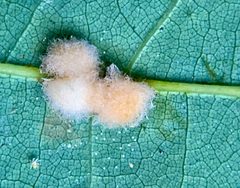
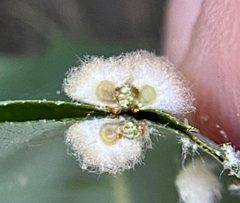
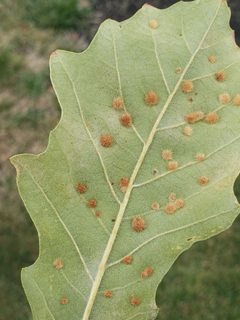
Pronunciation
How to pronounce Neuroterus quercusverrucarum: //ˌnjuːrəˈtɪərəs ˌkwɜːrkəsˌvɛruˈkɑːrəm//
These audio files are automatically generated. While they are not always 100% accurate, they are a good starting point.
Identification
Identification relies on examination of the galls induced on oak leaves rather than . The specific gall morphology—shape, texture, and location on the leaf—distinguishes N. quercusverrucarum from other Neuroterus . Adult wasps are minute (typically 1–3 mm), with reduced wing venation characteristic of Cynipidae. Precise identification requires knowledge of gall wasp and comparison with or detailed descriptions.
Images
Habitat
Associated with oak (Quercus) forests and woodlands. The inhabits the microhabitat created within its leaf galls on oak foliage.
Distribution
North America; distribution corresponds with ranges of oak . Documented observations span eastern and central North American oak-dominated regions.
Diet
Larvae feed on nutritive plant tissues induced within the gall. do not feed; they rely on energy reserves accumulated during larval development.
Host Associations
- Quercus - obligate plantInduces galls on oak leaves; specific oak associations require verification
Life Cycle
Exhibits the characteristic complex of many Neuroterus , involving an alternating system with distinct sexual and parthenogenetic () generations that typically produce different gall types on different plant tissues. The sexual generation usually emerges in spring, mates, and females oviposit into oak tissues to induce galls. The resulting asexual generation develops within these galls, with females emerging to produce the next sexual generation without mating.
Behavior
Females possess ovipositors capable of penetrating oak leaf tissue to deposit . The act of oviposition and subsequent larval secretions induce gall formation. Larvae complete development within the protected gall environment, emerging as through exit holes chewed through gall tissue.
Ecological Role
As a gall inducer, creates microhabitats that support a of specialized inhabitants including (guest organisms), , and hyperparasitoids. The galls represent a significant form of plant-animal interaction that structures in oak . The serves as for diverse parasitoid communities, contributing to the extraordinary diversity of Hymenoptera in temperate forests.
Human Relevance
Contributes to scientific understanding of biodiversity, plant-insect , and function. Galls may occasionally be noticed by naturalists and citizen scientists, providing opportunities for public engagement with entomology through platforms such as iNaturalist. No significant economic impact on forestry or agriculture has been documented.
Similar Taxa
- Neuroterus saltatoriusAlso induces leaf galls on oaks; distinguished by gall and the jumping of detached galls caused by larval movement
- Other Neuroterus speciesMany induce superficially similar leaf galls; precise identification requires examination of gall structure, location, and morphological characters
More Details
Taxonomic history
Originally described as Cynips quercus verrucarum by Osten Sacken in 1861, later transferred to the Neuroterus as the classification of cynipid was refined.
Research significance
in the Neuroterus, including N. quercusverrucarum, are subjects of ongoing research into the evolutionary of gall induction, the genetic basis of manipulation, and the diversification of .